

“No, Marcel, I don’t believe sending your designer clothes here is a great idea, really. All that would accomplish is giving the customs officers a wardrobe upgrade. By next week, half of Nairobi’s airport security would be strutting around in your Armani suits like underpaid Bond villains. Meanwhile, the black market—where 95% of all donated Western apparel ends up anyway—would be absolutely thriving, selling your well-intended generosity at a tidy profit. Your wardrobe alone might trigger an economic boom, possibly even a hostile corporate takeover of the secondhand clothing industry. But would a single orphan, a single starving child, a single soul in actual need ever touch so much as a thread of your donations? Absolutely not.”
Kibera, Kenya, August 2009
The human hurricane of a director sat across from me, radiating the kind of exhausted authority that comes from decades of watching the same tragicomedy unfold on loop. She had adopted a tone that suggested she had explained this exact scenario at least ten thousand times, possibly to someone even dumber than me.
It was the same tone you’d use when telling a particularly ambitious toddler that no, you cannot put the dog in the washing machine to “make it cleaner.” The same long-suffering patience of someone who had already stopped a child from licking an electric fence that morning and really didn’t have the bandwidth to deal with yet another idiot.
And yet, here we were. I nodded, absorbing this revelation like a drunk absorbing tequila—too much, too fast, and with the creeping suspicion that I’d regret it all in the morning. The reality wasn’t just bad—it was so spectacularly, insultingly stupid that it looped all the way back around to being genius. Like a man who just read a single Wikipedia page on economics and now thinks he can fix the global recession, I charged forward with the blind enthusiasm of a motivational speaker at a Ponzi scheme seminar.
“You see, Ma’am, I could send the donated clothes, shoes, and even toys directly to you!” I declared, practically vibrating with charity energy, my heart thumping with the self-righteous zeal of someone who’s just discovered his first “life-changing” TED Talk.
“I have many business friends—or so I still believed at the time—who could get together and make a fundraiser! People from my town could just drop by and donate whatever they own. We’d collect it, pack it, ship it, and have it sent straight to your institution! How does that sound?”
The director didn’t respond immediately. She just stared. Not the way someone stares at an adorable but profoundly stupid puppy, but the way a doctor looks at an X-ray and realises, with absolute certainty, that the patient is one sneeze away from total collapse. Her expression flickered between pity and the grim acceptance that she was, in fact, speaking to a real-life person who had somehow survived into adulthood. She squinted slightly, as if trying to determine whether I’d simply overdosed on caffeine or was actively in the throes of a midlife crisis—one that was arriving faster than the Mongol horde on Red Bull.
To be fair, she had a point. Until this very moment, I had never been particularly invested in charity. To me, this was about as thrilling as a Danish roundabout—an endless, repetitive loop of well-meaning but ultimately pointless discussions, with me stuck behind some metaphorical Volvo driver who refuses to commit and just keeps circling like a robotic vacuum cleaner having an mental breakdown.
Apart from a make-me-feel-better donation every Christmas to a German charity claiming to support a tear-jerking elephant orphanage in Nairobi, I had about as much interest in humanitarian work as a North Korean dictator has in public opinion polls.
It wasn’t until that fateful moment—a few days earlier—in my best friend’s yard that it even occurred to me to take a closer look at the suffering of my fellow earthlings. The ones less blessed than me.
Now, before you climb onto your ethical soapbox and start shrieking about what a “self-absorbed prick” I am, let me stop you right there.
Yes, we all live in our own little bubbles, blissfully preoccupied with our own special blend of avalanches of problems—but until that day, I had always found it far more productive to hand over small gifts to the countless homeless people in my own country. At least there, I knew where my donation went. At least there, I could make a small but tangible difference. At least there, I got a shred of gratitude in return, which—by the way—is really freaking encouraging when you’re trying to help people instead of just virtue-signalling on social media.
And if there’s one thing I despise more than a flesh-eating virus or a secondhand toilet seat bought at a garage sale in Gabon, it’s sanctimonious, self-righteous twats who lecture you about how to save the world, end hunger, eliminate malaria, and provide universal free parking—all while stepping over a homeless guy outside Starbucks like he’s radioactive waste.
Even better are the pseudo-intellectual oxygen thieves who declare:
“Oh, I would give money to a homeless person, but I don’t want them spending it on booze or cigarettes. I can’t support that.”
To these walking blocks of clotted self-importance, I always say:
“How about you worry about your own damn life? Donations aren’t supposed to come with terms and conditions set by people so dense they couldn’t spell ‘hello’ if you handed them a dictionary and a full week to practice.”
Want to help? Help. Don’t want to? Fine. But spare us the churchy TED Talk on Moral Economics.
Sorry, I got carried away…
Back to my grand, spur-of-the-moment scheme to single-handedly eradicate all suffering in Nairobi’s biggest ghetto—perhaps even throwing in free WiFi while I was at it—a voice, heavy with the kind of exhaustion that only comes from years of dealing with well-intentioned morons, dragged me out of my messiah mode. It sounded like it had traveled from another dimension—one where common sense still existed.
“Listen, Marcel, here is the problem.”
She took a deep breath—her expression was one of grim endurance, the look of someone who had long accepted that hope was a fool’s game but still had to humour the village idiot standing before her—me.
“The problem, you see, is not just that the customs officers will ransack the packages like a swarm of Somalis on happy hour at a gun sale. The other problem is that the taxes slapped on donated goods would be enough to bankroll a presidential campaign, fund a national ‘Ministry of Unnecessary Roadblocks,’ and still have spare change left to gold-plate a bureaucrat’s third mistress.”
And there it was. The final, aneurysm-inducing punchline. I blinked. My brain did a factory reset.
“So… you’re saying you can’t receive donations because it would bankrupt you?”
“No, I’m saying we can’t receive donations because they would never actually reach us—AND bankrupt us as well.”
Ah. Of course. The government—bless its coal-black, grasping little heart—would hold my well-intentioned charity hostage until it was either ransomed for a sum large enough to buy a small country or simply “reallocated” to more urgent causes.
And by urgent, I mean that within weeks, my donations would:
- Mysteriously vanish into a customs black hole, only to reappear at a high-end boutique run by some minister’s cousin, marked up 3000%.
- Resurface at a local market, where desperate parents would unknowingly buy back the very items meant for their own starving children.
- Ultimately end up in the closets of corrupt officials, who would strut around in donated Mickey Mouse T-shirts like they’d personally conquered Disneyland.
I had come here expecting hardship, poverty, suffering—but this? I had come here to snap a few tastefully framed pictures of poor but smiling kids, the kind that make people in first-class lounges feel momentarily introspective before ordering another gin and tonic. I had come here to catch a fleeting glimpse of “the other side”—the raw, unfiltered reality beyond the polished fantasy of luxury safaris, bush dinners where the only real danger is overcooked steak, and sundowners where Amarula and Whiskey flow like a priest’s moral flexibility.
I had expected corruption. Of course, I had. In any developing country, corruption isn’t just a problem—it’s an integral part of the ecosystem, the WD-40 that keeps the bureaucratic hellscape from grinding to a complete halt. But in my blinding optimism—the kind usually reserved for lottery winners and people who believe airplane applause makes a difference—I had assumed corruption, at the very least, operated with some level of dignity. That even the most unscrupulous grifters drew a line at robbing the orphans. That even the vultures in uniform had a shred of shame.
Boy. Was. I. Wrong.
This wasn’t just corruption. This was corruption that had shed all pretence and started doing naked cartwheels through a burning orphanage while demanding a bribe to put out the fire. This was a masterclass in institutionalised theft. This was fraud so advanced it deserved its own MBA program. This was a bureaucratic nightmare—an endless, self-consuming cycle of theft, stupidity, and paperwork. A Kafkaesque fever dream where trying to donate to orphans somehow resulted in lining the pockets of men whose net worth could fund a small dictatorship.
While my brain was busy chasing its own tail, running in circles like a headless chicken in a Manila meat market, the Dutch commander of this sinking cruise liner of tragic misery and I pressed on. Our little sightseeing tour had now fully evolved into a brutal, soul-dissecting reality check—the kind that doesn’t just slap you awake but picks you up, shakes you like a malfunctioning vending machine, and then drop-kicks you straight into the abyss of existential despair.
It wasn’t just eye-opening. It was the intellectual equivalent of getting blindsided by a wrecking ball made of bureaucratic absurdity, the kind that leaves you questioning not only the system but also your place in the universe, and whether or not lobotomies might actually be underrated.
She walked with militant purpose, explaining the details of her mission with the detached efficiency of a battlefield surgeon, outlining the sheer theatre of human despair unfolding around us.
Her goal? Simple. Keep kids from being casually discarded onto compost heaps like expired yogurt and—if the universe felt particularly generous that day—maybe, just maybe, provide them with a shred of a future before they aged out at the tender, totally career-ready age of sixteen, at which point their options narrowed down to “join a gang” or “wake up in a bathtub full of ice, missing a kidney.”
It was a real Cinderella story, except the fairy godmother had been mugged, the glass slipper was now property of the local warlord, and the pumpkin carriage had been stripped for parts before it even made it out of the driveway.
And me? I was soaking all this in, nodding like some enlightened philosopher who had just discovered that water is, in fact, wet—while periodically glancing down at my wrist, where my ludicrously expensive timepiece caught the African sun and hurled it back into the universe like a cosmic middle finger. A watch so fancy it could have fed half the kids here six-course meals until Christmas—or at the very least, bought enough black market bribes to expedite the “not getting thrown in a ditch” process for a few of them.
The weight of this realisation hit me with all the grace of an airborne grand piano—one of those cartoonish, full-keyboard catastrophes that flattens you into a human accordion. But only for a moment. Because, let’s be honest, guilt is like a drunk ex: it barges in uninvited, makes a scene, wails about all your moral shortcomings, and then, after making sure you've felt just guilty enough, stumbles back into the shadows to let you carry on with your life.
Guilt is cheap—cheaper than the knockoff designer bags peddled in back alleys by men with questionable immigration statuses. It’s a side note, a fleeting indulgence for the morally constipated, a decadent little emotion people toy with between sips of their organic oat-milk lattes and the dopamine hit of adding “Be More Compassionate” to their vision boards.
There is more. Guilt doesn’t change you. It’s a useless currency in the grand market of human suffering. It takes a hell of a lot more than a flicker of privileged discomfort to light a fire under someone’s bloated, leather-upholstered conscience. You don’t stumble into righteousness because you felt a twinge of shame between Pilates and brunch. No—real change requires pain, loss, and the kind of existential slap that rattles your bones and leaves you gasping in the wreckage of your own delusions. Therefor, to truly change, it takes something uglier. Something more personal. You don’t transcend until you're backed into a corner so tight you can taste the drywall—until the air gets so thick with your own denial that every breath feels like swallowing wet cement. You don’t evolve through quiet reflection or inspirational podcasts. No, real change only comes when reality sucker-punches you in the throat, holds your face to the fire, and makes damn sure you smell the burning.
Until then? You’ll keep rolling out the same, pre-packaged excuses like a malfunctioning Pez dispenser of self-serving bullshit.
“Oh, I’d love to help, but you know how it is—life’s just so busy.”
“Oh no, I would, but first I really need to focus on my own journey.”
“Oh, for sure, but I read this article that said self-care is important, and, well…”
And when those excuses start sounding as stale as a gas station sandwich labeled ‘Fresh’ in 2017, you pivot.
“But what can I do? I’m just one person.”
Let’s be real for a moment: ignoring suffering is the easiest skill humanity has ever mastered. I was so adept at tuning out misery that even a blind, concussed mole on sedatives had better situational awareness than me. Hunger? War? Children rummaging through trash heaps for their next meal? Tragic, yes—but not nearly as pressing as deciding whether to buy another overpriced camera or upgrade my already absurd collection of suits.
Maybe, deep down, I always assumed the charity game was just another casino—one where the house always wins and the poor just get shuffled around like decorative props for fundraising campaigns. There would always be some slick operator siphoning off donations to bankroll his beachfront villa, some bureaucrat slapping a “processing fee” on human suffering.
Or maybe… that was just the convenient little bedtime story I told myself, so I wouldn’t have to care. Who’s to say? Self-deception is a hell of a drug.
It’s easier to shut your eyes. Because really—who the hell am I to try and save the world? And why should it be me, anyway? That’s a job for someone else, right? Someone richer. Someone smarter. Someone with a grand vision and an ego big enough to think they could actually fix this mess.
Maybe that overhyped tech messiah with his glorified golf carts—no, they are not cars. Cars have real engines. Cars have cylinders. At least eight of them, arranged in a way that makes proper noise, not this smug, battery-powered hum that sounds like a dying blender on life support—the visionary nerd who thinks his genius level IQ is high enough to block out the fact that he has the social skills of a sponge.
Or maybe the software kingpin, the one whose operating systems are so gloriously defective you’d swear they were coded by a blindfolded goat herder in a tent with a personal vendetta against functionality, someone who had never actually seen a computer. The same man who, despite having more wealth than some countries, still somehow looks like he cuts his own hair with a lawnmower and dresses like a divorced dad who lost the custody battle and his will to live.
Or perhaps that bald, dead-eyed billionaire—the one shipping disposable garbage across the globe with the ruthless efficiency of a plague, grinding small businesses into dust like an industrial wood chipper set to annihilate. The one who treats workers like shoddy assembly-line parts, replacing them faster than a cheap toaster under warranty. The same guy who, despite having the GDP of a mid-sized country at his disposal, chooses to burn obscene amounts of money failing—repeatedly—to launch his overcompensating space phallus into orbit. Because apparently, the ultimate billionaire flex isn’t solving world hunger or curing disease—it’s hurling a giant metal tube skyward, desperately trying to break free of the planet he’s spent decades strip-mining for profit. He’s hell-bent on reaching the stars, despite barely being able to clear the clouds.
Can’t remember his name—something like a river, or a forest. Not that it matters. They all blur together at this level of detached, megalomaniacal insanity.
But definitely not me, or you. No, you’re too busy. Too small. Too powerless. Too wrapped up in your little existential security blanket, whispering 'not my problem' while the world burns like a lithium battery on a birthday cake. You have bigger things to worry about. Like which espresso machine best matches your Scandinavian minimalist kitchen, or whether the latest iPhone is worth an upgrade.
So you’ll keep walking. Keep swallowing. Keep choking it down like a bad oyster while telling yourself someone else will step up.
And then? One day, when there’s no one left to step up, and you realize you spent your entire life making yourself so small that the world forgot you even existed—maybe then, you’ll finally feel something. And the world will keep burning.
But I digress. And unfortunately for you, I’ve barely started today’s tale.
While we—me and Jonathan, my designated orphanage chaperone, a man whose job description seemed to be equal parts tour guide and damage control—stood before towering heaps of split green peas in 20kg canvas sacks, my mind was a blender set to “liquify.” I was absorbing every scrap of information, trying to wrap my head around the grotesque carnival of bureaucracy masquerading as charity.
My guide, a seasoned veteran in the dark arts of donation distribution, was peeling back the curtain with the casual air of a man describing the weather. He spoke of "reputable institutions"—almost all of them proudly waving some shade of blue in their logos—that had somehow perfected the magic trick of making other people’s misery profitable. He detailed how invoices were rewritten so many times, they had more layers than a Russian nesting doll, each adjustment inflating the final price until, somehow, one kilo of cornmeal or a bag of stale sourdough ended up costing more than a used space shuttle.
And the best part? No one questioned it. No one asked why a sack of maize flour suddenly had a price tag that made caviar look like a budget snack. The accountants—those glorified rubber stamps—were handed the final numbers and told to sign, no questions asked. After all, the towering fleet of brand-new Land Cruisers, air-conditioned glass-front offices, and first-class flights weren’t going to pay for themselves.
Even the bottom rung of the UN food chain—some fresh-faced intern barely old enough to grow a proper moustache—was granted a gilded existence: obscene base salaries, tax-free shopping, penthouse apartments, medical benefits that could resuscitate the dead, and enough paid vacation to make the Sultan of Brunei look like an overworked Uber driver.
Charity, my friend, was just another high-stakes casino. The only difference was that in this game, the chips were sacks of rice, the jackpot was a contract renewal, and the losers were, well… the people who were supposed to be saved.
“Did you know that every embassy employee from every nation represented here gets free access to every national park in the country?” my companion asked, his voice as casual as if he were discussing the weather.
No, I wasn’t aware of that.
“And did you know their families get in free too? Because, obviously, nothing screams 'diplomatic immunity' like an entourage of well-fed expat kids hand-feeding giraffes while the locals outside debate whether to spend their last shillings on bus fare or dinner.”
No, I didn’t know that either.
“Did you know that this little VIP treatment extends to all the NGOs? The UN? WWF? Every last one of them, rolling through traffic in their red-plated, air-conditioned land yachts like minor deities descending from Olympus. No bribes, no police shakedowns, no pesky inconveniences. Security guards don’t even make eye contact—just a quick, obedient salute before the gate swings open, like they’re ushering in the Second Coming.”
That was new to me.
“And,” he continued, his grin widening to something between a sneer and a death-row confession, “did you know that every single one of them—embassy staff, NGO messiahs, UN overlords—gets to shop tax-free? There’s an entire, members-only shopping complex near the American embassy, a little capitalist utopia where only they can enter. No taxes, no tariffs, no import duties. Just aisles upon aisles of imported whiskey, designer handbags, and premium steaks that never have to suffer the indignity of a Kenyan supermarket freezer. Meanwhile, outside, locals haggle over a handful of tomatoes like they’re negotiating an arms deal.”
I stared at him.
No, I definitely didn’t know that. But it was starting to make sense. The fleets of gleaming SUVs, the never-ending parade of charity galas, the crisp linen shirts and thousand-dollar ‘ethical fashion’ shoes—turns out, saving the world was less about sacrifice and more about scoring five-star perks while sipping duty-free champagne in a country where half the population couldn't afford a box of aspirin.
“How about those mountains of clothes collected across Europe ‘for a good cause’—the ones bundled up with teary-eyed promises of keeping the poor from freezing to death? You know, because even at the equator, it can get colder than a frozen margarita in a Siberian blizzard.”
I raised an eyebrow.
“Did you realize,” he continued, “that almost none of it—aside from what gets ‘misplaced’ by customs officials with stickier fingers than a toddler at a candy store—actually makes it to the people who need it? No, most of it ends up on the local market, hawked like any other commodity. Sometimes, the very NGOs meant to distribute it sell it to second-hand stores, where it’s resold at a markup to the very people it was supposed to help. Capitalism at its finest.”
I let out a low whistle.
“Oh, but it gets better,” he said, his smile the kind you see on someone right before they set fire to an institution. “We at the orphanage? We have to fight tooth and nail just to scavenge a few pieces for the kids—and we almost never win. What actually makes it through is either so shredded and foul even a half-blind hobo wouldn’t drape it over his dog, or it’s completely useless. Ever tried dressing a starving street kid in a wedding gown? Or a funeral suit? Because that’s what shows up—the discarded wardrobe of Europe’s midlife crises and bad life choices.”
I imagined a six-year-old orphan trying to play soccer in a moth-eaten tuxedo and had to stop myself from laughing. Not because it was funny, but because it was too perfectly, obscenely tragic.
“You see, I could go on until the next ice age,” my companion said, exhaling like a man who’d seen the belly of the beast and found it stuffed with bureaucratic paperwork and stolen aid money. He had the air of a disillusioned groupie who had just discovered his rock idol was bald, tone-deaf, and wearing glasses the size of marmalade jugs.
“But I’m not sure you really want to hear all that. Whatever you think you know, Marcel,” he said, eyes narrowing, “multiply it by ten. And then set it on fire. You have no idea—and you don’t want to know—how deep this abyss of corruption, mismanagement, stupidity, and greed really goes. It doesn’t just have layers; it has entire ecosystems, complete with bottom-feeders and apex predators.”
He leaned in slightly, as if revealing a great cosmic joke—one so dark that a black hole would look like a festive Christmas ornament in comparison.
“Always remember this: even if you wanted to help, you couldn’t. Not really. Not in any way that matters. You’re up against a machine designed to run on misery. An entire industry exists to ‘fight’ poverty—but not to end it. Why would they? In Africa alone, at least half a million people are employed by NGOs. What do you think would happen to all those cushy jobs if hunger and suffering suddenly stopped? If the world stopped needing ‘urgent interventions’ and ‘crisis relief efforts’?”
He let the question hang in the air like a vulture circling a dying animal.
“You think these grifters could get a real job? “You think they have actual skills beyond filling out funding applications and inventing new buzzwords to keep the donation gravy train rolling? Take away their tax-free salaries, their luxury SUVs, and their five-star hardship allowances, and half of them couldn’t manage a lemonade stand without drafting a 40-page impact assessment report and applying for emergency citrus relief funding. If the suffering ever stopped, these people wouldn’t just be unemployed—they’d be useless. And useless people, Marcel, will do whatever it takes to make sure they stay needed.”
By now, more than three hours of absorbing a steady intravenous drip of human despair, bureaucratic leprosy, and corruption so refined it could be bottled and sold as luxury cologne had left a visible mark on me. I was fried. My brain had entered overload mode, teetering dangerously close to a full system crash—blue screen of death imminent.
This was not what I had envisioned when I’d had that moment of divine stupidity in Shlomi’s garden, waxing poetic about making a “documentary” on the poor, as if dragging my expensive camera through a human landfill would somehow grant me artistic credibility. The plan had been simple: frame some artful misery, throw in a few biting lines about capitalism’s soulless machinery, then retreat back to my plush existence, occasionally reminiscing about the experience whenever Christmas guilt came knocking or when I needed to sound deep on the golf course. Maybe, if the gods of self-congratulatory journalism smiled upon me, I’d even bag a Pulitzer for my noble suffering.
I hadn’t anticipated being mentally curb-stomped by the truth. I hadn’t expected my entire worldview to be shaken like an apple tree under siege by a gang of overenthusiastic farmhands on a tight deadline. I hadn’t planned on being swallowed whole by the industrial meat grinder of reality, chewed up like an overcooked gas station kebab, and then unceremoniously spat out onto the cold, hard pavement like a century-old wad of chewing tobacco.
But really—what the hell did I expect?
I turned my gaze back to the towering mountains of split green peas, stacked so high they practically held up the rusting sheet-metal roof. Each sack was stamped with the proud insignias of USA and USDA, a bold declaration that America was—once again—on the front lines of the never-ending, mostly theoretical war to save the world. This particular warehouse was drowning in American goodwill, all generously funded by taxpayers who had no idea their hard-earned money was now sitting here, entombed in burlap, waiting for its turn to either feed the hungry or disappear into the great economic Bermuda Triangle of international aid.
Looking at the endless sacks, I couldn’t help but wonder: how much of this aid actually makes it to the people who need it?Aid, like a potted plant being watered from above, loses most of its sustenance before it ever reaches the roots. It evaporates on the leaves, pools in the cracks, and forms stagnant little puddles where an entire ecosystem of bureaucrats, middlemen, and well-fed executives flourish like fungus, bloating themselves on money that was never meant for them.
And the NGOs? The self-proclaimed saviours of the downtrodden? How much of their well-intended donations actually reach the cause? Ten percent? Fifteen, if they were feeling particularly generous? Because those fleets of white Land Cruisers, the prime-time TV ads starring heart-wrenching violins, the sprawling glass-front offices in prime real estate, the private planes, the tax-free perks, the outrageously cushy salaries—someone had to pay for all that.
Admittedly, I’m no Einstein when it comes to mathematics. Hell, anything beyond simple arithmetic passes me by like a fully armed Pakistani bomb-peddler, juggling live grenades, strolling past a TSA employee trained to confiscate malicious peanut butter jars for national security—undisturbed and unquestioned.
Still, even I could tell that by the time the cash had oozed through the greasy fingers of bureaucrats, sloshed into bloated offshore accounts, and been laundered through enough ‘administrative costs’ to make a cartel accountant blush, there probably wasn’t enough left to buy a Happy Meal—and even if there was, the NGO execs would probably find a way to bill it as 'field research' and eat it themselves.
“Jonathan,” I said, my voice betraying my chaotic thoughts, swirling like a laundry carousel in a hurricane. “I believe I’ve seen enough for one day. This was… quite an experience. And rather unexpectedly revealing.”
He led me to the car park, where my driver was already waiting, looking as indifferent as a priest counting Sunday donations. On our way out, we passed by the director’s office—the domain of that human thunderstorm wrapped in business casual, a woman with the relentless persistence of a souvenir peddler in front of the Sphinx and the battle-worn face of someone who had fought wars that no one ever wrote history books about.
It was impossible to guess her age. The lines on her face weren’t from time but from the sheer, daily absurdity of holding this operation together with the determination of a woman who’d duct-taped the cracks of reality itself. Her eyes, framed by thick glasses, still burned with something rare—something you don’t find in the air-conditioned NGO towers or behind the tinted windows of diplomatic Land Cruisers.
She wasn’t here to climb some self-righteous ladder of virtue signalling. She wasn’t here for a cushy expat life filled with tax-free shopping, free-flowing grants, and diplomatic immunity from both parking tickets and moral accountability. She wasn’t here to schmooze with embassy staff, flexing her ethical superiority over cocktails served on silver platters.
She was here to help. Period.
To make a difference—no matter how small, no matter how fragile, no matter how absurdly stacked the deck was against her.
I wondered if that was worth more than all the grand speeches, blue-insignia logos, and carefully curated charity galas combined.
“It was a pleasure meeting you, Ma’am. Thank you for taking the time to invite me into your world of compassion and hope.”
I heard the words coming out of my mouth, but they felt like they belonged to someone else—some wide-eyed optimist who still believed in the integrity of institutions, the power of good intentions, and the idea that change was just a well-placed donation away. That guy had been mugged, beaten, and left for dead somewhere between the sacks of split peas and the realisation that charity was just capitalism’s guilt-ridden stepchild.
“I have to admit, none of this comes close to what I expected to see. Though, to be fair, I don’t really remember what I expected to see in the heart of East Africa’s biggest ghetto. A tragic facebook backdrop? A live-action documentary on suffering? Something profound to ponder over a double-shot espresso back home? Either way, I’ll try to digest what I’ve learned and see if anything sticks when I get back to my life. I hope I didn’t waste your time.”
She studied me for a moment, like a doctor evaluating a patient who didn’t yet realize they were terminal.
“Marcel,” she said, her voice calm but laced with something I couldn’t quite place—amusement, maybe? Pity? Some mixture of the two? “Please don’t publish any pictures of me.”
A flicker of vanity? I hoped so. It made her more human, and I needed that—because right now, she felt like some mythical creature that wasn’t supposed to exist in a world like this.
“And for all the other photos you took, make sure they’re displayed in a respectful way.”
I nodded. That seemed like the bare minimum at this point.
“I’m certain you’ll find a cause you’re willing to contribute to with more than just donations or second-hand clothes. You can’t see it yet, but you have a fire burning for whatever you set your focus on. And since you’re a wildlife photographer, maybe in the wild, you’ll find something worth fighting for. Something your heart will tell you is the right thing to do.”
And with that, she was gone—back to her battlefield of quiet victories and unseen sacrifices. No speeches. No grandstanding. No PowerPoint presentations with colour-coded graphs about “impact.” Just another day of pushing a boulder up a hill while the world barely noticed.
I climbed into the Land Cruiser, feeling like I’d just been ejected from a world I hadn’t fully understood but knew had left a permanent mark on me. The driver didn’t ask questions. Why would he? This was just another day in Nairobi. Another mzungu getting a peek behind the curtain before retreating back to their normal life.
And yet, one thing nagged at me—the way she’d completely ignored my career as a businessman. Instead, she’d pointed at my photography, as if that was the part of me that actually mattered. Was she trying to tell me something? Was there a hidden message in there?
I didn’t know, but for the first time in a long time, I felt like I needed to find out.
“So, how was it? Have you seen enough 'real' life yet?”
Shlomi was waiting for my return, lounging with the kind of ease only achievable by someone who had long since made peace with the fact that the world was fundamentally screwed.
“Did you know there’s a golf course right next to Kibera? You could play a few holes and get one last panoramic view of the ghetto—from a more lofty perspective. Want a drink?”
I stared at him. The absurdity of his words was like a slap, but not an undeserved one. A golf course. Right next to one of the largest slums in Africa. A place where people fought over food scraps and lived stacked like human Tetris blocks. Meanwhile, just a stone’s throw away, the well-to-do were taking leisurely swings, concerned only with their handicap and the quality of the imported grass beneath their feet.
The contrast was obscene. Then again, so was everything. Shlomi wasn’t being cruel. He wasn’t mocking me. He simply saw things as they were. He’d been here long enough to understand something I was only beginning to grasp:
Passion is not enough.
The will to make a difference is not a currency that holds any value in a business built on greed and exploitation. It doesn’t feed the hungry, it doesn’t change the system, and it certainly doesn’t keep you from being steamrolled by the unrelenting machinery of bureaucracy and corruption. I had walked into Kibera thinking I might capture something real—something raw, powerful, maybe even important. Instead, Kibera had captured me. It had chewed up my naive notions, ground them into dust, and spat them out at my feet.
“I’ll take that drink,” I finally said.
Because right now, I needed something strong to wash down the bitter taste of reality.
Little did I know—blissfully unaware of the chaos I was about to court—that this soul-searching detour into the abyss of human tragedy would launch me on a trajectory so violently miscalculated that even NASA would have disavowed it. I was about to become something far worse than lost—I was going to be misplaced, like an unclaimed suitcase endlessly circling life’s baggage carousel, waiting for an owner who no longer existed.
A permanent foreigner in my own existence—about to become a ghost in my own life—locked in a nexus between two worlds, belonging to neither, fluent in both, yet understood by none, like a bilingual parrot trapped in an aviary of deaf ornithologists.
Returning to my former comfort wasn’t going to be an option—not unless I was willing to lobotomise myself with reality TV and start worshiping at the altar of overpriced oat milk and Instagram enlightenment.
Society was going to move forward, sprinting towards goals so hollow and ridiculous that even a Wall Street coke addict might pause mid-binge and ask, “Wait, is this really the move?”
My old life? Gone. My future? Hijacked by revelations I hadn’t asked for. It was going to feel like coming home from a war—one I hadn’t enlisted in—only to find that the country I was supposedly defending had transformed into something unrecognisable, complete with its own Orwellian rulebook that nobody had bothered to send me.
The world I had once called home was going to evolve without me—the things I had once valued, the people I had considered friends—all of them were about to forget me, discard me, erase me like an old voicemail they never intended to listen to. And the worst part? I wouldn’t even see it happening.
I’d just wake up one day to find my existence quietly redacted, like a footnote in a book no one bothered to finish, like a ghost at its own funeral, screaming at mourners who had already forgotten my name.
I wasn’t just becoming obsolete—I was about to become unnecessary.
Marcel Romdane,
signing off and wondering if a joyful day on the golf course wouldn’t have been the better choice of entertainment…

I was kneeling in a Nairobi orphanage, camera in hand, still marinated in the smug afterglow of Western purpose, when it happened—the breadcrumb moment.
A discarded child, plucked from a trash heap like a broken toy, blinked at me.
And my ego—still fresh from first-world inflation—whispered:
“You’ve arrived.”
I thought I was doing “impact.”
Spoiler: I was doing stand-up comedy at the gates of hell, and the crowd wasn’t laughing.
What followed wasn’t sainthood.
It was cosplay.
Bad cosplay.
Like Comic-Con, but instead of dressing up as Batman, I went full White Saviour:
delusional, over-accessorised, and with all the emotional resilience of a soggy tea bag.
This wasn’t my spiritual epilogue.
It was the prologue to a humanitarian face-plant—a jet-fuelled dive into a swamp of customs forms, crushed illusions, and enough self-inflicted wounds to qualify as performance art.
The child?
Tossed aside by the world like a debit receipt from a failed life.
Me?
Still posing for a donor newsletter like a deranged Labrador with a Nikon and a savior complex.
Nairobi didn’t steal my innocence.
I hand-delivered it—wrapped in Excel sheets, shrink-wrapped in righteous optimism, and dipped in the kind of blind enthusiasm that makes people join pyramid schemes or buy Teslas.
The return package?
A mental suitcase packed with bureaucratic PTSD, a Swahili swear dictionary, and the realization that I was now a ghost in my own life—a man too German for Kenya and too Kenyan for brunch.
This wasn’t healing.
It was emotional bloodletting with jazz hands.
No yoga circles. No enlightenment. No oat milk epiphanies.
Just me, screaming at customs officials because my humanitarian cargo apparently needed a license, a bribe, and a ceremonial goat sacrifice to enter the country.
And no—this isn’t your TED Talk redemption arc.
This isn’t “Eat, Pray, Save” with a side of quinoa and guilt.
This is a detonation report.
Filed by a self-propelled idealist who thought he was signing up to help… and accidentally became the poster child for well-meaning stupidity on international tour.
So buckle up.
We’re not in Zurich anymore.
We’re in Chapter IV.
Where compassion meets customs regulations.
Where the hero dies in Act One.
And where “From Riches to Rags” isn’t a metaphor—it’s the GPS reroute into mayhem.

Kibera from above.
Years later, I soared above the birthplace of my delusions—Kibera.
A twisted, rust-coloured lung gasping under the weight of good intentions and aid packages stamped with stars and stripes.
Down there, it all began: the naive dreams, the misguided “mission,” and my slow-motion crucifixion by bureaucracy, dressed up as benevolence.
I took this photo from my own aircraft—a flying middle finger to every smug charity gala and white Land Cruiser parked in a five-star hotel lot. The skies once mocked me. Now they bore witness.
What began in the mud of this humanitarian purgatory spiralled into an odyssey of madness, loss, and the unhinged idea to fight corruption and save elephants… from a Super Cub.
Because obviously—what could possibly go wrong?
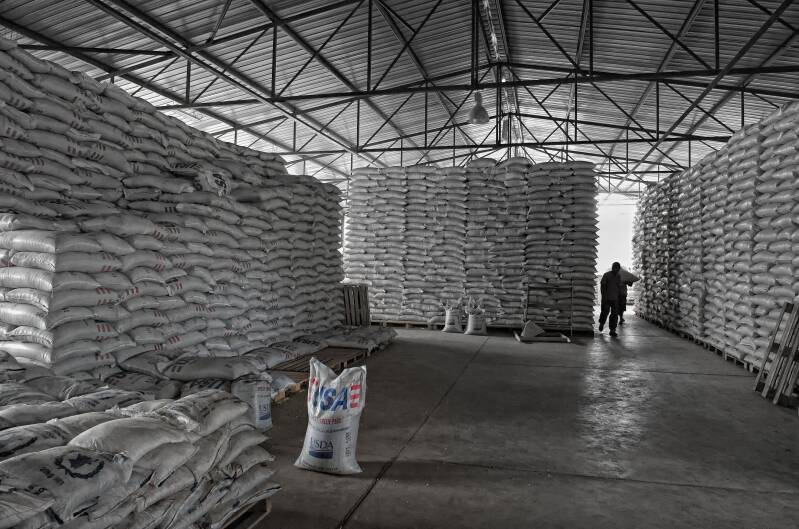
This isn’t aid. It’s a tombstone for accountability.
Captured by Marcel Romdane inside a Nairobi warehouse groaning under the weight of USDA-labeled charity, stacked higher than the hopes it was supposed to feed. This is what happens when good intentions get wrapped in plastic, shipped across oceans, and suffocated by protocol.
These sacks—funded by hardworking taxpayers—aren’t feeding the hungry. They’re propping up an industry that thrives on delay, celebrates inefficiency, and launders morality through white Land Cruisers and glass office towers.
And the beneficiaries? Often left waiting, watching, and wondering where their share vanished.
Even I—mathematically challenged and generally distracted by shiny objects—could tell a Happy Meal had a better chance of reaching the hungry than this bureaucratic sandbag fort.
📍 From Riches to Rags: An African Odyssey – Part IV: Where Good Intentions Go to Die.
(Trigger warning: contains truth, sarcasm, and the sudden death of blind optimism.)
Kommentar hinzufügen
Kommentare