

FLY4ELEPHANTS
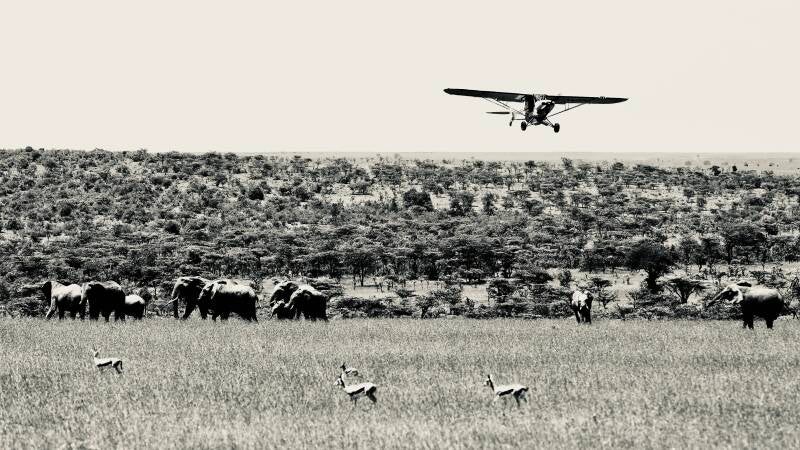
A field-based conservation aviation initiative in Kenya, 2012–2014
Fly4Elephants was a Germany-based conservation aviation initiative founded in 2012 by Marcel Romdane.
Developed in response to rising elephant poaching in Kenya, the project used a light aircraft platform to provide aerial presence, field support, and public awareness in and around the Maasai Mara ecosystem.
The central idea was simple: in landscapes where poaching pressure was rising and ground coverage was limited, a small bush aircraft could provide visible aerial presence, rapid observation, and practical support at relatively low cost.
Fly4Elephants was created to test that idea in real field conditions.
Timeline
2009
Marcel Romdane observes a clear increase in elephant poaching during a safari in the Maasai Mara.
2010
A return visit confirms that the situation has worsened. In late 2010, he decides to become a pilot and pursue an aviation-based conservation role.
January 2011
Flight training begins.
May 2011
A rebuilt Piper Super Cub is acquired and modified for African bush operations.
December 2011
The aircraft is packed into a container and shipped to Kenya.
January 2012
Marcel relocates to Kenya and begins the process of license conversion, aircraft registration, company formation, and local operational setup.
Early 2012
Conservation groups and NGOs are approached with an offer of aerial support free of charge apart from fuel costs.
June 2012
Fly4Elephants is founded in Germany as a charity association.
September 2012
Operations begin from Ol Seki Camp in the Naboisho Conservancy, Maasai Mara ecosystem.
2012–2014
Fly4Elephants carries out aerial support, observation, presence patrols, and related conservation work in Kenya.
Background
Before launching Fly4Elephants, Marcel Romdane had visited Kenya repeatedly as a wildlife photographer.
During visits to the Maasai Mara in 2009 and again in 2010, the increase in poaching became impossible to ignore. What began as concern gradually turned into a decision to act more directly.
In late 2010, he chose to become a pilot with the specific aim of supporting elephant conservation through aviation.
Flight training began in January 2011. During that period, he identified a rebuilt Piper Super Cub as a suitable aircraft for rough-field and low-level operations in remote terrain.
Together with his wife Nicole, he invested personal resources into acquiring and adapting the aircraft for African conditions.
The Super Cub was modified for bush operations, including increased fuel capacity, larger tires, reinforced gear, and upgraded navigation equipment.
After several months of preparation and technical work, the aircraft was shipped to Kenya in December 2011.
Arrival in Kenya and Operational Setup
Marcel relocated to Kenya in January 2012.
What followed was a prolonged period of administrative and logistical work: license conversion, aircraft import procedures, registration, company formation, assembly, and the practical challenge of establishing a working base in a new country.
The aircraft arrived in Nairobi in early 2012, but operational readiness was delayed by procedural and regulatory hurdles.
During this period, Marcel also began reaching out to conservation groups, NGOs, and wildlife organizations across Kenya.
The offer was straightforward: aerial support would be provided free of charge, with partner organizations only asked to cover fuel costs.
Those conversations were important, but they also revealed a major structural problem. While the usefulness of a light aircraft was easy to understand in principle, even minimal operating costs proved difficult to sustain through existing structures.
Founding of Fly4Elephants
By mid-2012, the project had reached a turning point.
Either the effort would end, or it would need its own structure.
In June 2012, Fly4Elephants was founded in Germany as a charity association intended to support and fund the aircraft’s conservation role in Kenya.
At around the same time, a relationship that had developed with Hemingways Collection became operationally important.
Through this connection, Marcel and Nicole were introduced to Ol Seki Camp in the Naboisho Conservancy in the Maasai Mara ecosystem.
In September 2012, Fly4Elephants began operating from Naboisho.
This gave the project what it had lacked until then: a meaningful field base in a landscape where aerial presence could be directly relevant.
Field Role and Activities
Fly4Elephants was designed as a practical aviation-based support platform rather than a conventional NGO program.
Its value lay in mobility, visibility, and speed.
Activities included:
- aerial patrol presence over conservancy boundaries and surrounding areas
- support for rangers and ground teams through observation and reporting
- identification of suspicious activity and potential poaching-related movements
- transport support in urgent situations, including veterinary assistance
- public awareness through documentation, media coverage, and direct field storytelling
The project also demonstrated something important: in remote conservation settings, a small aircraft does not need to replace ground operations to be useful.
Even limited airborne presence can extend visibility, improve situational awareness, and create a deterrent effect.
What the Project Demonstrated
Fly4Elephants showed that a light aircraft, operated with local relevance and persistence, could play a meaningful support role in a conservation landscape.
It also showed that the barrier was not only technical or operational.
The aircraft worked.
The concept had practical value.
The deeper challenge was structural.
Several lessons became clear:
- aviation utility alone is not enough to sustain a mission
- even low-cost field aviation requires stable financial backing
- legal and regulatory setup can consume far more time and energy than expected
- credibility in conservation work depends not only on usefulness, but on durable partnerships and institutional resilience
- self-funded founder energy can launch a mission, but it cannot replace long-term structure
Why Fly4Elephants Matters Today
Fly4Elephants was the field test. It proved both the value and the fragility of small-aircraft conservation work. The lessons learned in Kenya remain the foundation for Marcel Romdane’s current conservation aviation thinking and the development of a more durable next chapter.
Erstelle deine eigene Website mit Webador