

“Are you ready? Sure you want to do this?” Shlomi asked, with the casual tone of a man inviting you to brunch, not a descent into the rectal cavity of urban despair. I looked at him—unsure, unprepared, and utterly incapable of backing down. Why? Because if I did, this bastard would hang it over my head for the rest of eternity like the Sword of Damocles, except less sword and more insufferable smugness.
“Is it going to be worse than the hotel in London you booked me into last year?” I fired back, already dreading the answer.
“Possibly,” he said, and I swear he almost smiled. “This is East Africa’s biggest slum you’re heading into. I’m afraid even London looks like a vacation in the Caribs compared to that.”
Now, let’s pause. Shlomi—the same lunatic who twelve months prior catapulted me into the seedy underworld of London’s underbelly—a third-class brothel disguised as a hotel—had apparently decided that my life lacked texture. That particular hotel, I should note, would have made a Rhodesia refugee camp look like New York’s Four Seasons. It was the kind of place where even the cockroaches filed complaints, and the plumbing screamed like it was possessed by the tormented souls of failed Roman-era plumbers.
That trip through hell’s back alley was my initiation into a realm of purgatory that I would soon become painfully familiar with. It also laid the indestructible foundation of my utter disdain for London—a city that seems to exist purely to punish human optimism. The Tube alone could induce PTSD in Buddhist monks, and don’t even get me started on Heathrow. Heathrow’s security personnel seem hand-picked from a pool of people who failed personality tests for prison guards or medieval plague wardens.
Or let’s talk about the cameras. There are more CCTV cameras, speed traps, and traffic lights in London than at an international paparazzi convention in Las Vegas. If you stitched together every surveillance lens in that city, you could create a massive glass dome capable of single-handedly solving Britain’s chronic rain problem—just slap it over the whole country and call it the world’s largest terrarium. One hour of casual strolling through London’s holocaust of radiation and surveillance is enough to give you instant terminal cancer in sixteen different organs, including ones you don’t technically have yet. But I digress…
None of that mattered now. Because here I was, climbing into the back seat of a Toyota Land Cruiser, ready to eject myself directly into Nairobi’s most infamous human blender: Kibera. A place so notorious that even nightmares hesitate to go there. A place where dreams beyond your next meal are a luxury no one can afford. A place where empathy is a foreign concept, likely confused for a new strain of malaria.
And me? I was a walking ATM with legs. No credit card swipe necessary—just a smile, a firm handshake, and your wallet, kidneys, and possibly your soul were fair game. Welcome to Kibera. Let’s dance.
The drive, however, was uneventful—at least by Nairobi standards, which meant we only narrowly avoided four head-on collisions, two minor stampedes, and one rogue goat performing what I can only describe as a suicidal interpretive dance in the middle of the road. In most parts of the world, this level of chaos would spark a state of emergency. In Nairobi, it’s Tuesday.
Venturing anywhere within the gravitational pull of this city means signing an unspoken waiver where you accept that physics, logic, and basic human decency no longer apply. The streets are a living, breathing entity—part obstacle course, part demolition derby, part National Geographic special gone horribly off-script.
Let’s break it down. There are dogs—feral, disinterested in traffic laws, and possibly immortal—darting across the roads like they’ve got places to be and no regard for your bumper. Donkeys, too, just loitering about like they own the place, casually pulling carts loaded with enough cargo to break several labor laws in at least three countries. Then, as a special bonus, you’ve got the occasional Maasai warrior, grazing cattle on a traffic roundabout as if urban sprawl is just a mild inconvenience for his livestock. Only, it’s not. But the cows don’t care, and neither does he.
And then there’s the Matatu—the Kenyan lovechild of a baked beans can and a rave party bus. These things are technically public transportation, but in reality, they’re overcrowded death traps on wheels, held together by duct tape, plastic grocery bags, and bass systems capable of triggering small earthquakes. Inside? People are packed tighter than a sticker on a public toilet door—layered, sweaty, and fused together in a way that defies the laws of molecular physics.
Outside? You’ve got riders hanging off the rails, the roof, and sometimes each other, clinging to life like Afghanis to the fuselage on a departing Air Force plane at Baghran. I didn’t know whether to salute or pray.
Honestly, if disaster and mayhem wanted a masterclass, this would be their alma mater. Nairobi traffic doesn’t just flirt with the apocalypse—it takes it out for dinner, proposes, and elopes in a flaming rickshaw.
But I was spared the privilege of navigating this circus of carnage. Shlomi—bless his dark, conniving soul—had arranged for me to be chauffeured, probably less out of concern for my safety and more to avoid the paperwork involved in my death. His driver, a man who operated the Land Cruiser like a tank commander storming a war zone, became my saviour. Without him, I would still be lost somewhere between Upper Hill and downtown, screaming at Google Maps and bartering with picki-picki drivers for my soul.
As we barrelled forward, the scenery began to morph—not unlike a slow descent into post-apocalyptic absurdity. The city’s polished façade peeled away like cheap wallpaper in a flood. High-rises gave way to structures that looked like they’d survived a hurricane, an earthquake, and possibly a small alien invasion—all before breakfast. Buildings leaned at angles that defied engineering and common sense, constructed out of materials that would make a termite laugh: rusted scrap metal, damp cardboard, and hope. I wasn’t entering a neighbourhood.
I was entering Mad Max: Nairobi Drift. And the further we drove, the clearer it became—this wasn’t just the edge of civilisation. This was well beyond the edge, past the cliff, and halfway down the abyss.
Next stop: Kibera.
And then… we arrived. We had barely crossed the invisible threshold separating Nairobi’s usual chaos from the official realms of misery and despair, when—nothing happened. No riots. No child soldiers with machetes. Not even a flaming tire rolling down the street like a hellish tumbleweed. Nothing.
I was, to put it mildly, shocked. And not the “oh no, I forgot my umbrella” kind of shocked—the “have I been unknowingly transported to an alternate universe” level of existential bewilderment. Kibera, this notorious ghetto, this apocalyptic poster child for human suffering… didn’t look all that different from the rest of Nairobi’s charming outskirts. The same patchwork of tin-shack shelters that looked like they’d lost a bar fight with a garbage truck, the same unpaved roads redder than a vampire’s diet, the same smell of overcooked gloom marinated in goat fumes.
And yet… it was peaceful. Cheerful, even. I was expecting Mad Max meets Dante’s Inferno. What I got was kids laughing and kicking around a semi-deflated football made of twine, dust, and probably the souls of failed UNICEF projects. They played in the streets—because, of course, cars didn’t come here. Not for fear, no. Simply because no car could come here without immediately dissolving into rust, regret, and shattered dreams.
Now, none of these kids went to school, mind you. Education here was about as real as Bigfoot or a customer service representative at Amazon who actually helps you. They were born into Kibera, and Kibera is where they’d die. There was no tooth fairy, no Aladdin’s lamp, no white knight galloping in on a unicorn powered by solar panels to whisk them away to opportunity. No. If you were born in Kibera, you had two choices: survive or disappear. And disappearing was alarmingly easy.
Yet, amid the complete absence of hope, there was this baffling cheerfulness—as if the universe had forgotten to tell them they were supposed to be miserable. These people owned nothing, lived in structures barely distinguishable from an abandoned refrigerator, and yet—they laughed. And let me be clear: they paid rent. Rent. As in, for the privilege of living in a coffin made of cardboards with leaky walls and a toilet situation that can only be described as “biohazardous roulette.”
I had assumed—naively, like the pampered idiot I was—that hell, at least, would be rent-free. That if you’ve reached the bottom rung of society, the universe might throw you a bone and let you live in squalor for free. Not so. Even the underworld’s slums have landlords, and if you miss a payment, eviction is swift and brutal. Kibera’s eviction policy makes New York’s housing market look like a cozy Airbnb. Because here, they don’t just throw out your furniture—no, they might keep your daughter as collateral until you cough up your overdue rent.
At least in New York, they probably won’t take your offspring as pawn. Then again, it is New York, so I can’t rule it out entirely. The only difference is in Nairobi, they’ll tell you to your face they’re keeping your child; in New York, it’ll be buried in the fine print of your lease agreement, right under the clause where your soul is repossessed for failure to sort your recycling.
We kept on creaking down the sandy excuse for a path, the Land Cruiser groaning like a hungover ox being forced to run a marathon in a sauna. Then—out of nowhere—we stumbled upon something that didn’t belong. Something so violently out of place, it was like spotting Rambo in a Disney cast, or a gay shower scene in an Iranian film. It should not have been there, and yet there it stood.
A proper building. Not a tin shack. Not a makeshift hut stapled together with discarded dreams. No, this was real infrastructure, and in this part of town, it stood out like a Rolex in a rummage sale.
Looming above the solid entrance was a sign, bold and uncompromising:
“The Frances Jones Abandoned Baby Centre.”
And that was it. No glitz. No glamour. No smiling Hollywood halfwit frozen in a poster, holding a baby like it’s a prop for their next Oscar campaign. No “Save the handicapped kids” banners with airbrushed sadness. Just a monolith of grim necessity, a fortress of function carved from despair and maintained with quiet, thankless resolve. It was too real to advertise, too honest to market, and in today’s world, that made it feel almost alien—like it had crash-landed from a parallel dimension where people give a damn without asking for applause.
But here’s the kicker—the moment that punched me square in the moral compass. What gnawed at me immediately, like a swarm of philosophical termites, was the contrast between this place and, say, the elephant orphanage I’d visited earlier—a place so soaked in emotional manipulation it might as well have handed you tissues at the entrance and charged for emotional trauma by the minute.
There, it was all carefully monetised tragedy and they had it all:
T-shirts screeching “Save Dumbo or Die”, as if not buying one would send you to hell via express elevator, bracelets made of elephant toenails, artisanal elephant dung soap for sale—because nothing screams ethical consumerism like smearing yourself with the excrement of an endangered species while sipping your organic oat milk latte.
Hell, for a “donation,” you could adopt your very own elephant, which, let’s be honest, meant paying for a creature you’d never see again while getting monthly emails about its bowel movements like some twisted subscription to National Geographic: Bowel Edition.
There were stickers for your car, banners for your social media, perfectly teary-eyed staff ready to guilt-trip you into oblivion. It was virtue-signalling Disneyland, with just enough suffering to make you feel like a good person for opening your wallet.
But here? Nothing.
No merch. No marketing. No elephant-branded soap to make you feel morally superior in the shower. And why is that?
Because abandoned, handicapped babies don’t make good photo ops. Their suffering is too real, too raw—too non-transferable into Instagram likes and cocktail party anecdotes. There’s no moral high ground to gain by helping them, no “look at me saving Africa” narrative that plays well with the yoga-retreat crowd. This isn’t charity as performance—it’s charity as survival. And nobody wants to pay for reality when they can sponsor a baby elephant with a bowtie instead.
Also—and this hit like a freight train of truth—unlike the parade of NGOs I’d seen clogging Nairobi’s roads with Land Cruisers worth more than the naval fleet of Norway, there were no flashy vehicles here. No chrome-plated motorcycles. No obnoxious logos slapped across the side of vanity trucks. Nothing. Just humility and hustle, the kind you don’t see because it’s too busy actually fixing things to pose for a photo.
As we rolled into the compound—the iron gate yawning open like the jaws of redemption—I was greeted by efficiency incarnate. A large playground, shockingly clean. Kids of all ages laughing without the slightest clue of the Kafkaesque absurdity of their circumstances. The staff moved like zen ninjas, calm but alert, handling chaos with military precision. Not a single Facebook influencer in sight.
And then—she appeared.
A tiny woman, the size of an economy airline seat, but with the presence of a battle-hardened general. Dutch, she told me. A veteran of compassion, commanding this kingdom of empathy like a benevolent warlord.
Leaving my driver—and any lingering delusions of “saving Africa”—behind, I entered her realm. Here, nobody was performing. They were just doing the work. And that, frankly, was the most radical thing I’d seen in years.
We started—praise every deity known and unknown—with coffee, the elixir of the gods, brewed by a woman who looked like she could have tamed the four horsemen with a spoon and a stare. I’d braced myself for something resembling hot swamp runoff filtered through an old sock, but no—this was liquid defiance. All hail the Dutch!
As I sipped this miracle in a mug, the tiny director—a five-foot tempest of efficiency—began calmly dismantling any illusion I had about the world being even remotely sane. She laid it out, straight as a guillotine’s blade. Where do the children come from? Trash heaps. Literal mountains of decay, rotting debris, and the occasional human soul discarded like spoiled meat. They’re dumped there—sometimes still breathing, barely—because to their families, they’re not children. They’re malfunctioning burdens, biological bad karma wrapped in frail skin.
A cosmic punishment. A curse to be rid of quietly, before the neighbours start whispering and the shame becomes contagious. So the staff—these battle-hardened saints in civilian clothing—run patrols like war medics, combing through junkyards of dejection in search of lives the world has thrown out with yesterday’s filth. Some parents, in an act of shaky empathy or sheer cowardice, upgrade their abandonment strategy and drop the child at the doorstep—like leaving a malfunctioning toaster on the curb with a note: “Free. Broken. You deal with it.”
And then the director looked me in the eye, no fear, no apology, and told me:
“What you’re about to see may change how you see everything—especially your world of abundance.”
I—smug fool that I was—brushed it off, flashing the unearned confidence of a man who thinks watching ‘Titanic’ once qualifies as ‘trauma-tested.’
I’d seen stuff. I’d traveled. I was seasoned. Hardened.
Untouchable. Or so I thought…What came next tore that illusion to shreds and fed it to the dogs of existential reckoning.
We started our little “sightseeing” tour into the chambers of hope and defiance—because that’s what this place was: a fortress of tenderness barricaded against a world gone feral. Our first stop? The infant room. A sunlit sanctuary for the smallest survivors—newborns to six months old—who had somehow managed to crawl, metaphorically and literally, from humanity’s trash pile into this bizarre slice of heaven. Each crib, unassuming but immaculate, stood under its own mosquito net—a delicate veil to fend off yet another plague these forsaken souls didn’t need: malaria. Because apparently, being abandoned like faulty appliances wasn’t enough—no, nature had to take its cut too.
And yet, beneath those nets, for the first time in their short, battered existence, they were spared. Safe. Seen.
Next, we moved to the toddler quarters—children up to two years, in beds slightly larger but steeped in the same impossible serenity. The air was thick with a kind of sacred defiance, as if the very walls whispered, “Not here. Not today.” We passed through room after room, each one a testament to the radical notion that even the discarded deserve dignity. And then we reached the final stop—the domain of the older children, some in their teens, veterans of life before they even got a chance to live.
Toys were scattered on the spotless floor—not by accident, but by intention, as if chaos had been given permission to exist without fear. Morning’s ghost still haunted the air, a blend of hurried footsteps and the scent of sleep not yet shaken.
The director, calm but radiating the exhausted aura of someone who’s waded through a thousand metaphorical (and possibly literal) minefields, dropped the next dark truth like a bomb over Baghdad—precision-engineered to vaporise hope and leave only the charred remains of denial smouldering in its wake: these children, these “malfunctions of fate,” weren’t allowed in regular schools. Not because they couldn’t learn, but because the outside world—the so-called “normal” world—wanted them gone. Gone from sight, gone from thought, gone from existence. Parents of “healthy” kids would revolt at the idea of their precious offspring breathing the same air, seeing it as a cosmic insult—a karmic landmine threatening to blow up their fragile bubbles of denial.
This wasn’t the passive-aggressive exclusion of the West. It wasn’t veiled in bureaucracy or smothered in fake smiles like in the “civilised modern world.” No, this was stone-cold rejection—brutal, unapologetic, and final.
“We don’t want you here.” Full stop.
Many of these children wore trauma not like baggage, but like skin—inseparable, permanent, fused. Imagine your first experience of life being a trash heap, flies and filth your welcoming committee. Imagine waking up to the stench of rot, unsure if you’re alive or already in hell. That’s not just trauma. That’s a reality so grotesque it makes war zones look like beach resorts.
And yet, in this compound—this surreal outpost of empathy weaponised against despair, a fortress of grace amid the wasteland—there was peace. Not the fragile, marketed peace sold by NGOs in Land Cruisers, but the real, gritty kind, stitched together with exhaustion and unyielding love. No T-shirts. No bracelets. No Instagram pity porn. No “Adopt-a-Child” programs that make you feel better about ignoring them in real life. No currency of guilt to be exchanged for social clout.
Just people. Doing. The. Work. Outside the gate, the world raged—a relentless meat grinder of poverty, violence, and collective apathy. Inside? Stillness. Purpose. Not silence—calm. Controlled chaos, yes, but chosen chaos in the service of something higher: hope that doesn’t beg for attention or money. Hope that bleeds, sweats, and never asks for thanks.
In that moment, standing amid beds, toys, and the shattered remnants of discarded lives being pieced back together with nothing but willpower, it hit me like an anvil to the chest: this wasn’t a charity. This was rebellion. A middle finger to a world that dared to define “value” in terms of ability and beauty. Here, the unwanted weren’t just wanted. They were defended. Loved. Armed with dignity. And that? That was the most dangerous, powerful thing I’d ever seen.
Next stop on this whirlwind tour of brutal reality: the Physio and Exercise Room. And let’s just clear this up right now—this wasn’t your air-conditioned, influencer-infested, selfie-temple masquerading as a gym where people wage spiritual warfare over protein powder brands and cry when their yoga mat doesn’t match their aura. No one here was counting macros or flexing for likes. No tearful tantrums over a soccer ball with a scratch, or existential crises about a stained T-shirt. God forbid! The horror! How could one possibly exercise under such Third World conditions?
There were no “motivational quotes” plastered on the walls, no gladiator music blaring from speakers to fuel your deadlift dreams, and certainly no one whining about losing a ball game because the referee dared to breathe incorrectly. Nope. This was war. Real war. Not the kind you train for while sipping spinach smoothies, but the kind where the battlefield is your own traitorous body.
This room didn’t radiate “athletic potential” or “elite performance.” It radiated the raw, unfiltered battle to simply exist with some shred of dignity. Here, the Olympics of survival played out daily. Forget somersaults or sprints—this was about touching your own damn nose without your limbs staging a mutiny. Holding a spoon? That was a gold medal moment. Managing to feed yourself instead of wearing your breakfast like modern art? Standing ovation.
Participation medals? Please. This wasn’t the land of over-praised mediocrity where little Timmy gets a trophy for showing up and breathing. There were no delusional parents projecting their crushed Olympic dreams onto their children here. No sidelines full of shouting dads who couldn't jog to the mailbox without a coronary, screaming at their “gifted” offspring to run faster.
Instead of gleaming courts or turf fields, there was a giant red mat, soft enough to cushion the falls but not the harsh reality: most of these kids would never run, never jump, never even walk unaided. But still they tried. Crawling, dragging, straining against muscles that worked about as well as a dial-up modem in 2025.
Here, failure wasn’t measured in lost games—it was measured in the inability to stand. Victory? A step. A crawl. A grip that didn’t fail. Every inch gained was a slap in the face of the universe that had written them off. And they fought for those inches. Every single day.
No crowds. No applause. Just the quiet, relentless grind of trying to reclaim a piece of humanity in bodies that society had already tossed on the discard pile.
This wasn’t a gym. It was a crucible. Where kids who had been labeled as “burdens,” “curses,” or “bad karma come to life” were burning through that narrative one agonising movement at a time. If there was any glory here, it wasn’t televised. It wasn’t filmed in slow motion to the soundtrack of violin strings and soft lighting. It was raw. Bloody. Real. And far more heroic than any touchdown you’ve ever screamed over on a Sunday.
We stepped out into the garden area. The yard—like everything else inside the compound—didn’t just exist, it defied. It operated on an entirely different frequency, like some pocket universe wedged between the teeth of chaos, utterly detached from the misery grinding outside its gates. It wasn’t merely well-kept—it was surgically maintained, as if nature itself had been bullied into submission. Lawns clipped with military precision, flowers that had no business blooming in this part of the world somehow thriving as if they too refused to surrender to reality. Luxury and bleakness were playing chess here, and despair was losing.
In the middle of this paradox sat a child—if you could even call her that in any conventional sense. Her age? Indeterminable. Her limbs? Mere suggestions of what they were meant to be. Arms and legs twisted by fate and forsaken by function, she was folded into the sagging cushions of a wheelchair so ancient it could have rolled out of the trenches of Verdun. It wasn’t one of those modern contraptions you see zooming around airports, controlled by an app, boasting USB chargers and climate control. No, this thing looked like it had been forged in hell, possibly repurposed from a medieval torture device or scavenged off the set of Saving Private Ryan. The wheels groaned like they were carrying the sins of mankind. On second thought, they probably were.
This chair had seen things—biblical things. If objects could scream, this one would never stop. It had likely ferried more broken bodies than a wartime ambulance, soaked in the sweat, blood, and tears of forgotten souls. It was a throne of ruin, a monument to endurance in a world that doesn’t give a damn.
But none of that mattered. Not the rust, not the history, not the existential stench of hopelessness. Because in that moment, the world shrank to two people: one small, broken, immobile; the other patient, focused, weaving strands of hair with a precision and tenderness that mocked the chaos outside the gates.
There was no audience, no applause, no hashtags or “inspirational” reels to be made here. Just an act of rebellion—installing a spark of dignity in a life that had been stripped of everything else. Plait by plait, defying the void. Injecting a whisper of luxury into a reality that had never known it. It wasn’t much. But it was everything. Hope, it turns out, wears no cape. Sometimes it crouches by an ancient wheelchair in a sun-scorched garden, weaving braids like they’re armour.
Close by, a barber was engaged in what could only be described as combat grooming, hacking away at a young teenager’s hair with the precision and enthusiasm of a Marine drill sergeant sculpting a fresh recruit into something that might one day take orders without drooling. The kid—a teenager by age but somewhere between a toddler and a 5 year old in terms of mental processing power—sat there, grinning like someone who just discovered gravity, completely oblivious to the clumps of hair raining down around him like confetti at a funeral.
Physically? The boy was intact. —a rare win from nature’s chaotic slot machine. Arms, legs, head all in the right places, and no spare parts rattling around. Mentally, however, nature had taken a prolonged coffee break, possibly gotten drunk, and mailed in the brain with postage due. He had that classic, sunny disposition common among the severely mentally handicapped: friendly and perpetually smiling. Language? Not really. Thoughts? Dubious. Coherent sentences? A pipe dream.
Now, here’s where it gets philosophical in the most deranged way possible: maybe—just maybe—the real kick in the teeth isn’t being broken. It’s knowing you’re broken. This kid? Blissfully unaware. Reality didn’t knock at his mental door because, frankly, there was no door—just an open field where ideas went to die.
Maybe this is the punchline—the grand finale of the cosmic clown show, served with a side of nihilism and chased by a shot of tequila straight from the abyss. Picture it—and stay with me here—this isn’t mockery, it’s cold, surgical logic, the kind that makes therapists quietly update their résumés. Being dead, comatose, or dumber than a paper bag full of pencils? You don’t know. You don’t care. You’re not at war with your own thoughts at 2AM, pondering your existential void or if that weird mole on your back is planning a coup. That’s everyone else’s problem—apart from that little blemish, of course. That little bastard’s might have plans.
You? You’re living your best life in blissful oblivion, no memory, no concern, just pure, undiluted presence.
Here’s the thing—and let’s not dance around it, because I’m not sugarcoating any of this—I looked at this particular handicapped kid and, yeah, a part of me felt sorry for him.
But more than that, I was overwhelmed by a surge of raw, almost brutal gratitude. Grateful—not for my own situation, but for the simple, astonishing fact that kindness still exists. That there are people—genuinely selfless human beings—who’ve devoted their lives to helping others, to lifting up those who, through no fault of their own, got dealt a losing hand in life’s rigged, sadistic card game. Who roll up their sleeves and wade into the mess to help those crushed under the heel of life’s indifference. These aren’t virtue-signallers or hashtag warriors—they’re the real deal, saints in street clothes, and they don’t want your applause.
Because let’s be honest—life isn’t fair. Evolution? Even less so. Evolution isn’t some feel-good story about everyone getting a gold star. It’s never been about fairness—it’s always been about survival of the fittest. Nature doesn’t care if you’re weak, unlucky, or born into chaos; it discards the less gifted, the broken, and the misplaced like yesterday’s trash. That’s not cruelty—that’s biology, red in tooth and claw, grinding the unfit into dust for eons.
And yeah, I know how this sounds—real rich coming from someone privileged enough to string together a coherent sentence while sipping life’s cocktail of comforts. But hear me out—it’s not a lack of empathy. It’s the opposite. What twists my gut into knots isn’t the reality of suffering. It’s the audacity of some self-anointed, outrage-addicted Westerners who pretend to suffer. The coddled, entitled whiners who parade their imagined grievances like war medals.
These entitled fringe-dwellers shriek about being victims, demand the spotlight, and throw tantrums because the universe doesn’t revolve around their emotional paper cuts—while real pain, real struggle, real injustice gets drowned out in the noise.
It’s not just insulting—it’s obscene. A mockery of real pain. They’ve turned victimhood into currency, suffering into performance art, and empathy into a hollow spectacle. While others bleed, they post. While others starve, they sulk. While the world burns, they argue about who gets the biggest slice of attention. And that? That’s the real sickness. Not the brokenness of the unfortunate, but the wilful, gleeful decay of those who pretend to be broken just to stay relevant in a world where outrage is cheaper than truth.
But, again, I digress…
We left the barber—who, let’s be honest, probably moonlighted as the janitor, gardener, driver, and possibly local shaman—behind with his cheerful client, the two of them laughing and chatting away like life was one big all-you-can-eat buffet of joy, happy, like clams in a hurricane—no idea what’s going on, but too content to care.
Meanwhile, I was knee-deep in a spontaneous existential crisis, ambushed by my own “deep” thoughts like some pretentious philosopher who accidentally wandered into the wrong movie.
And the epiphany? Oh, it didn’t hit me like a divine lightning bolt or a flaming chariot of enlightenment. No, it crept in like a medieval thumb screw, turning ever so slowly, ratcheting up the pressure until my brain was marinating in its own discomfort. It set up a tent in my frontal lobe, lit a campfire, and started roasting every smug assumption I’d ever made about what life was supposed to be. It was like having a Zen monk and a used car salesman arguing in my head—one chanting “be present,” the other yelling “BUY MORE STUFF”—while I quietly contemplated setting the whole circus ablaze just to get some peace.
This realisation planted a seed—not a majestic oak of wisdom, no, more like one of those questionable plants you find growing through cracks in a nuclear wasteland. With the right care, maybe it’d blossom into a tree of insight, but let’s be honest, it’d probably just fester into a weed—an invasive little bastard choking the life out of my otherwise pristine mental garden of self-satisfied comfort.
It clung to my mind like a splinter dipped in lemon juice and regret—an incessant, nagging itch on the brainstem, forever poking me with the uncomfortable notion that maybe, just maybe, life isn’t about accumulating shiny things or stacking up achievements like some capitalist Pokémon collection. Maybe it’s about being—about presence, connection, existence. Or maybe I just needed a drink and a nap, and this whole episode was the mental equivalent of low blood sugar and poor life choices.
Either way, that thought wasn’t leaving. It was there, like a drunk uncle at a family gathering—loud, inappropriate, and refusing to shut up until it had ruined dessert for everyone.
“Marcel,” the director’s voice cut through the fog in my head like a chainsaw through a fruit cake—muffled, sticky, and completely out of place. “Do you want to keep going and get a look behind the scenes as well? Do you want to know about the struggles, the skirmishes, the battles and the wars we have to fight in order to keep doing what we do? The corruption, the big NGOs, and where all the donation money really goes while we’re left fighting over scraps?”
It wasn’t a question. It was an invitation. No, a dare. A one-way ticket down a rabbit hole carved out of blood, sweat, and bureaucracy so thick it could suffocate a sauropod. Me? I didn’t know if I wanted to know anything ever again. Not about suffering, not about the grotesque puppet show behind the curtain, not about the machinery of “saving the world” grinding people into dust.
But, listen to this—once the curtain’s yanked back, once you get that first look at the rot underneath, oblivion is no longer an option. Normal? That ship’s sailed, crashed, and burned. You can’t unsee the gears of the machine once you’ve seen what they’re grinding. So, I deadpanned, masking whatever shards of sanity I had left:
“Sure, Ma’am. Show me.”
And how that decision worked out for me? What a complete, flaming, rabbit-hole-of-horrors mess it turned into? Yeah... that’s a story soaked in chaos, corruption, and a fair bit of emotional arson.
But we’ll get to that. Next chapter.
Marcel Romdane—
pulling the plug on my mental drain, and waiting to see what circles the hell-water takes.

This door doesn’t open for Instagram.
Here I stood — camera in hand, ego in shambles — stepping into Kibera’s human blender. No white saviour theatrics, no elephant orphanage props. Just a brutal doorway into a world that ignores your lenses.
From Riches to Rags, Part III – Shots Fired: How a Camera Took Me from the High Life to Nairobi’s Human Blender.
Beware the lens that claims to save. Sometimes it only shows how deep you’ve buried yourself.


This isn’t a Hallmark moment. This is the Nairobi reality I never saw in brochures: A girl in a wheelchair, cradled by routine and resilience, while her caretaker braids defiance into every strand. No filters. No pity. Just the brutal poetry of human strength disguised as a weekday chore.
From From Riches to Rags: An African Odyssey, Part III – Shots Fired.
Where the camera stops lying and starts weeping.
A young boy in Kibera, Kenya, wearing a red shirt with a fading heart — staring down the lens like he knows the world won't flinch first. Captured in From Riches to Rags: Part III – Shots Fired, this image marks Marcel Romdane’s turning point: when the camera stopped being a tool and started becoming a mirror.

Welcome to Kibera — Nairobi’s corrugated labyrinth of survival, rust, and reality. A cluster of kids gather around a jerrycan like it’s holy water, framed by fences made from broken promises and roof sheets one gust away from becoming machetes.
This isn’t poverty porn. It’s From Riches to Rags: Part III – Shots Fired — the moment Marcel Romdane stopped being a photographer and started becoming collateral damage in his own philanthropic delusion.

Reality Check, Turn-Down Service Not Included.
Welcome to Nairobi’s no-frills chamber of resilience — where threadbare blankets, mosquito nets, and institutional beige are the luxury suite. This wasn’t just a sleeping room. This was the moment I realised “doing good” came with night sweats, broken fans, and a new understanding of what “comfort zone” meant when all comforts were removed.
Excerpt from From Riches to Rags: An African Odyssey, Part III – Shots Fired.
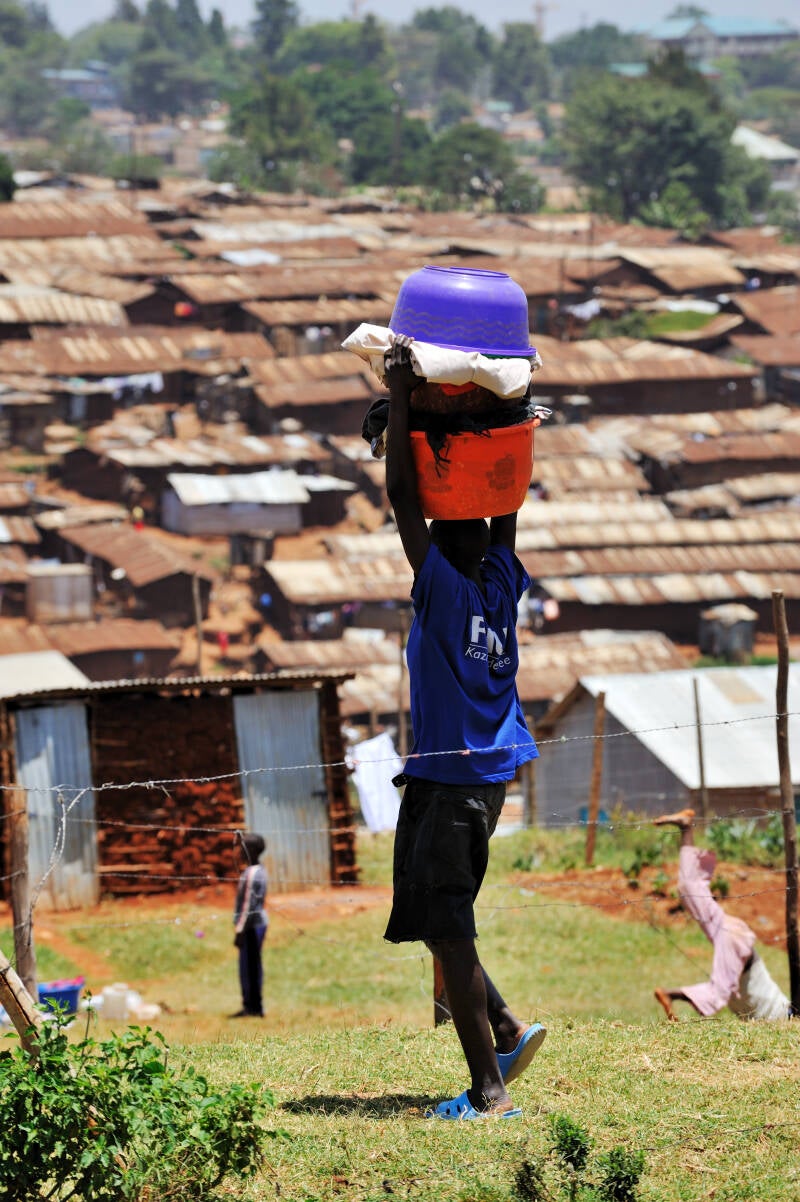
Young boy in Kibera balancing plastic basins on his head like a Nairobi Cirque du Soleil act — slum rooftops sprawling behind him like rusted dominoes of poverty and perseverance. From Riches to Rags: Part III – Shots Fired.
Kommentar hinzufügen
Kommentare