

“No, Marcel,” said David. Flat. Measured. The voice of a man informing you that your visa application has been rejected on the grounds of emotional instability and spiritual fraud. He paused—scanning the interior of the building like it had personally colonised his ancestors.
“I don’t believe we can come in there with you.”
There was a tragic clarity to it.
The kind reserved for lost tourists being told the embassy had closed in 1964 and the country it represented no longer exists.
Meanwhile, I was already halfway through the club’s mahogany gates—an architectural hallucination from a time when powdered wigs, maritime theft, and strategic gin abuse were viable career paths. A place where empathy had been permanently removed for restoration.
The air wasn’t cold in the modern sense.
It was colonial cold—the kind that preserves fossils, dries tears, and ices over justice for future examination.
“Why not?” I chirped, spinning around like a Disney side character who hadn’t read the room since birth. My pilot license—still laminated and vaguely tacky from Nairobi humidity—hung around my neck like a diploma from the University of Misplaced Confidence.
“We’re in! They’ve got recliners. Real ones. And a man in a bowtie whose only job is to refill your gin and your self-importance. It’s like aviation heaven—if heaven had a racial dress code.”
David gave me a look.
Not angry. Not even sad.
Just... tired.
The look of a man who knows exactly how this ends—and is just praying there’s alcohol at the crash site.
He glanced at his companion, the other David, as if confirming that yes—this was happening.
The Muzungu in front of them, with the cowboy hat, terminal optimism, and an accent that sounded like someone trying to colonise vowels, was absolutely serious.
David #2 didn’t speak.
Possibly couldn’t. I wasn’t sure if he was shy, suffering from catastrophic dental failure, or just a decoy built for emotional buffering.
Leading theory: genetically convenient cousin, deployed as social scenery. There was no obvious relation—just a shared name, a shared cloud of dread, and a joint responsibility to stop an overconfident, recently certified flying idiot from sparking an international incident before lunch.
“No,” David repeated.
Slower now.
With the weary patience of someone explaining to an armed and emotionally unstable Maasai goat herder that livestock is not acceptable collateral at a central bank.
I blinked.
Then grinned harder.
Because I had not—in any meaningful way—understood a single part of what was happening.
“I think we should go somewhere else,” David muttered, rubbing his temples, trying to erase the last two minutes from memory.
His expression was that of a man watching a preschool fire safety demo gone rogue—flames, glitter, and one kid licking the extinguisher.
I, meanwhile, was still basking in the afterglow of mahogany-grade delusion, glowing with entitlement, freshly laminated self-worth, and the faint, chemical optimism of a man who thinks “postcolonial” is just a hipster décor style.
“But why?” I chirped, genuinely perplexed, like I’d just been told gravity was optional on weekends.
“What are you worried about? The check? Don’t be silly—I’ve got this!”
I puffed up with the misplaced generosity of someone offering to pick up the tab at a funeral he accidentally caused.
David blinked.
Then sighed.
Not the kind of sigh that ends a sentence.
The kind that ends hope.
The kind of sigh auditors make before they say “We’re going to need to speak to a supervisor.”
He looked around—not to gather his thoughts, but to check for exits.
Spiritual ones.
And then, gently, carefully, he delivered the sentence.
“We’re Black.”
He said it with the resigned precision of someone trying to reboot an idiot’s conscience using only patience and subtlety.
“Yes!” I replied proudly, chest inflating as if I’d just solved apartheid using a gluten-free group chat.
“I noticed when we met. I’m extremely observant.”
David didn’t blink. He just endured.
“We wouldn’t exactly be… welcome in there,” he said, carefully.
Gently.
Like someone coaxing a sleepwalking coloniser off the buffet table.
“It’s not for us.”
I blinked.
Still buffering.
A blue screen of social context failure flickered behind my eyes, along with a spinning hourglass and faint elevator music.
“What do you mean? I’ve seen plenty of Black people in there!”
I beamed like I was solving racism through volume and charm.
“This is Kenya! Your country, basically! Not the Berlin Olympics in 1936!”
David stared.
Not angry.
Not amused.
Just… disconnected.
“Yes,” he said eventually, voice now collapsing like a pension fund in a Ponzi scheme.
“But they all work there.
You know—the guys checking every 15 seconds if your lime wedge has achieved optimal colonial pH levels.”
Silence.
Administrative silence.
The kind of silence normally filled with stamp ink and career-ending decisions.
My brain spun its propeller.
Slowly.
Stupidly.
Wobbling through a no-fly zone of reason.
“So what?” I beamed, brightly—like ethnic dynamics were just another conspiracy theory to be solved by smiling harder. “That just means there are more locals inside than guests! That’s… inclusive! You should feel right at home!”
David inhaled.
Deep.
From somewhere between his spleen and whatever organ generates restraint.
It wasn’t just a breath.
It was a farewell letter to hope.
David glanced toward the other David—who was now gazing into the void like it owed him back pay and an apology. His face had the emotional range of a corpse forced to attend a destination wedding with no return flight.
Eyes hollow.
Post-hope.
He was either buffering… or decaying.
“Yes, Marcel. You're right,” David said finally.
I nodded helpfully, basking in the radioactive warmth of being correct in a situation I fundamentally did not understand.
“There are Black men in there.
The doorman.
The barman.
The janitor.
The parking guy.
The gentleman who folds napkins into tiny imperial elephants.
The coatroom coordinator.
The toilet paper replenishment associate.
The guy who endlessly adjusts the chandelier with the haunted precision of a colonial ghost.
And maybe—maybe—one local who doesn’t work there.”
He paused.
“But he’s a pilot.”
“Oh,” I said,
As the penny finally dropped…
And disappeared directly into the Mariana Trench of my ignorance—never to resurface.
Even sonar would have given up.
But naturally—because this was me—I had a plan.
Of course I did.
Because nothing says “this will end well” like a half-baked solution cooked in a pressure fryer of cultural ignorance and laminated self-esteem.
“Well, listen…” I chirped, shifting into Turbo Diplomatic Idiocy™,
my voice bright with confidence, my brain already trying to file for asylum.
“What if… I tell the porter you two are working for me? Should be fine. Flawless, really.”
Their stares could have peeled the paint off a colonial-era latrine.
And then sterilised it.
“You know,” I continued—possessed now by the full spirit of Delusional Damage Control™, Mark III—
“You could carry my luggage. Or be my drivers. Or—hear me out—aviation officers. I am a pilot now, after all.”
I was in my element: full-throttle, propeller-screaming idiocy.
Grinning.
Unhinged.
Short of slapping David on the shoulder like we were old colonial chums reuniting at the polo club.
“I might even throw you a tip!” I chuckled, absolutely convinced I was solving racism with pocket change and charm.
I beamed—proud of my humanitarian workaround.
Like the neighbour’s kid who painted the family dog with marmalade and was now expecting applause.
David just looked at me like I was Exhibit A in the Museum of Colonially-Induced Stupidity.
And I was.
The other David remained frozen—still locked in his best impersonation of a KCAA employee staring into a government-funded existential abyss.
Emotionally unavailable.
Spiritually expired.
Possibly decomposing.
Or just rebooting into Safe Mode.
Kenya Customs, Kebab Stands & Cardiac Arrests — February, 2012
Strangely, my elaborate diplomatic masterstroke—disguising the two Davids as my personal butler and part-time gardener—was received with the same enthusiasm as a fresh turd on a birthday cake.
So, with the magnanimity of a colonially confused idiot, I surrendered.
I suggested that perhaps they might have a better idea—
a more honourable establishment, where we could discuss our potential business relationship without anyone being lynched, arrested, or denied entry at the door by a man wearing polished shoes and post-imperial trauma. This, of course, turned out to be a grave mistake. Possibly my gravest—on a list that already includes
“Let’s fly to Kenya”
and
“Let’s go on safari.”
And that’s how we ended up in what can only be described as the subterranean Nairobi reboot of a failed kebab stand of doom—East Africa’s answer to a fallout shelter designed by a man with meat poisoning, no budget, and unresolved childhood trauma involving sheep.
The walls sweated mystery oils.
Everything glistened with the unmistakable sheen of expired ambition.
And the smell?
A rich, haunting blend of scorched goat, diesel fumes, and generational regret.
If depression had a scent, and it had been barbecued over a tire fire—this was it.
We sat at a table that looked like it had been passed down through prehistoric oral tradition, possibly dating all the way back to Lucy—the ancient hominid believed to have roamed these very lands long before seasoning or frosting were invented.
The tablecloth was even older.
Not so much cloth as fabricated despair—something between burlap, ash, and the forgotten hopes of three previous republics.
David #1 sat across from me, beaming.
Possibly because the place was run by a cousin named Moses.
Possibly because he was now in his element—where goat smoke met financial extortion in sacred union.
Or possibly because he knew something I didn’t, like which part of the meat not to touch if I wanted to see tomorrow.
David #2 hovered beside him—silent, unreadable,
like a software update nobody asked for, still buffering, still somehow draining battery.
We perched on plastic chairs that had lost the will to live sometime in the late ’70s. Structurally speaking, they were closer to string theory than furniture— held together by physics, prayer, and ancient soda spills.
Nicole sat beside me.
She—bless her patience, or whatever tattered remnants of it still clung to life—looked like someone who had just discovered the honeymoon was actually a dental conference… held in a parking garage.
I had promised her a lavish lunch at the Aviation Club.
Mahogany furniture. Colonial guilt. Cucumber sandwiches.
Possibly a monocle with every gin and tonic.
Instead, she was now balancing a plate of sheep—with the texture of a deflated wallet—alongside the looming threat of gastrointestinal collapse, quietly wondering how her life had led to this exact, goat-scented moment.
Me?
Radiant.
Deliriously euphoric.
Glowing with deranged optimism and sniffing the air like a golden retriever on LSD—tail-wagging through the chaos—convinced I was experiencing cultural enrichment, not a slow-motion stomach apocalypse.
Every scent—sweaty cumin, scorched goat cartilage, and what might’ve once been an onion with PTSD—hit me like spiritual awakening in a spice market run by overzealous yogis with no sense of restraint.
I inhaled deeply, trying to “savour the moment.” I’d seen people do this on National Geographic.
“Breathe in the essence of a foreign land,” they said—some anthropological nonsense about cultural respect and aromatic immersion.
What I got instead was a faceful of unwashed armpit, wrapped in self-marinating underwear—the kind that had seen things, absorbed things… become things.
I began coughing and wheezing like a squeaky toy running the Ironman Triathlon—violently attempting to breathe and failing in full surround sound—
while Nicole sat beside me, quietly considering divorce, homicide, or diplomatic asylum at the nearest embassy with functioning plumbing.
The source?
Unclear.
Possibly the failed deodorant of the approaching waiter.
Possibly the dead goat in the kitchen.
Possibly another cousin of David.
(The waiter, that is. Though statistically, the goat was a possibility too.)
But we hadn’t assembled here for the exquisite culinary experience.
No one was here to discuss wine pairings, or the subtle terroir of diesel smoke and cow cartilage.
We weren’t here for the food. We were here for the container.
Yes. The container.
The one holding my dreams, my delusional ambitions, tools, spare airplane parts, a full wardrobe, and whatever fragile remnants of logic I’d had left before entering this bureaucratic safari dressed as a pilot and thinking I’d survive it.
Enter: The Davids.
Two men. One name. Zero blinking. Negative accountability.
They ran something called import-export, which I quickly deduced stood for:
“Import your money. Export your dignity.”
They came highly recommended by Chris—aviation demigod and owner of a charter operation so small, the planes doubled as picnic tables during off-hours and possibly emergency caskets on weekends.
This was the first moment since the Aviation Club disaster that I had time for a closer look at my logistical saviours.
The Davids, beyond sharing a first name and a mutual disinterest in blinking, also shared what I can only describe as DNA-level tailoring preferences.
They looked like they had just stepped out of a UN crime tribunal, or an international conference on how not to dress.
Their suits?
Architectural disasters.
Oversized to the point of being multi-occupancy dwellings, with enough shoulder padding to survive low-speed vehicle collisions.
The colour palette ranged from Somber Bureaucrat Grey™ to African Drought Brown™—a spectrum specifically designed to camouflage among filing cabinets and moral ambiguity.
These weren’t outfits.
They were emotional voids.
A sartorial Swiss Army knife:
One outfit to marry your wife,
bury your father,
and defraud your client—all in the same day.
But of course, there was logic to this madness.
As I’d come to learn over the years, suits in certain corners of Africa were strategically tailored to fit—
and I use the term “fit” in the loosest, most Geneva-violating sense possible—
the entire extended male family.
And naturally, there was a price to pay for this kind of versatility:
The suit looked good on absolutely no one.
David #1 was drowning in fabric—
shoulders slouching, sleeves flapping like windsocks in purgatory.
David #2, on the other hand, looked like the suit had given up mid-production, possibly after learning his measurements.
His arms—clearly evolved for tree-swinging or interpretive dance—had to be folded like an accordion just to prevent his sleeves from turning into medieval weapons.
At this point I began to suspect orangutang ancestry was involved—if not legally, then spiritually.
“$4,000,” David #1 declared, as casually as if he were suggesting we try the pineapple Fanta— or the homemade cheese his brother-in-law aged in a motorcycle helmet.
“And your plane’s released in no time.”
I immediately ejected half of my coffee across the table.
Coughed.
Wheezed.
Coughed again—this time existentially.
Then I stared.
Hard.
No blinking.
Just the creeping sensation of cardiac arrest, coffee dripping from my chin, and a faint buzzing in my skull as my credit score quietly flatlined in the background.
FOUR. THOUSAND. DOLLARS.
That wasn’t a quote.
That was a down payment for a cruise liner.
Or a ransom note written in aviation fuel.
“Errr… isn’t that a little… excessive?” I wheezed, suddenly gasping like a goldfish left on a windowsill during a heatwave.
“I was thinking… $400. Maybe a tip. A few Bic lighters. A resolved handshake.
A discreet envelope containing two cigarettes and tickets to the local karaoke competition. You know… the usual.”
David leaned back like a non-smoking villain in a poorly-lit documentary—the kind who poisons people with import fees and then explains it was “just business.”
“Ah yes,” he purred. “$400 is the published rate.”
I exhaled in dumb relief—
like a drowning man who mistakes a shipwreck for a cruise ship because it still has chairs.
“No taxes,” he added.
“Nothing on aviation imports.”
Great, I thought.
Finally, a win.
A small, pathetic, possibly imaginary win.
Things weren’t so bad after all.
I nodded reassuringly toward Nicole.
She didn’t speak.
She didn’t blink.
She simply gave me the calm, silent expression of a woman who had just realised she was engaged to a man who truly believed international diplomacy could be solved with lighters and laminated licenses.
He continued,
smile widening like a pothole in the Rift Valley after three days of bribery-induced rain.
“You could pay just $400,” he said,
voice now laced with doom—
the exact tone a divorce judge uses when announcing your ex-wife is getting the house, the car, and 30% of orbiting satellites.
“Plus a small tip for me…”
I lit up.
Like a moron.
Beamed across the table at Nicole.
She did not beam back.
She was eyeing the Davids like they were prepping to harvest our kidneys—and not even for resale.
Just out of habit.
“But,” David added—
and oh God, there’s always a “but” in Africa when it comes to paperwork and hope—
“There are currently… 60,000 containers at Nairobi Customs.”
He let that hang in the air like the stench of overcooked lamb intestine and dashed dreams.
“To find yours?” he continued,
now surgically removing joy from my chest cavity with the precision of a bored dentist.
“Well… it depends.
On the customs officer.
His family.
His cousin.
His cousin’s goats.
The goat’s new wife.
Her driver.
The bishop.
Sometimes the bishop’s driver is the goat.
You see how delicate this is?”
I did not.
I hadn’t even seen my container in two months. For all I knew, it was now part of a mobile chicken coop parked behind Terminal 4.
Nicole looked like she wanted to file a restraining order against the entire continent.
David #2 chewed silently on his charred lamb chop, eyes scanning the horizon for his next victim—or possibly just hoping for a second helping of despair.
I, meanwhile, was still under the charming delusion that logistics meant “You fill out a form, and someone does their job.”
Instead, I was about to bankroll the entire Kenyan Port Authority for the rest of the fiscal decade.
Not to retrieve a container.
But to earn the right to begin looking for it.
And that’s when I realised something truly terrifying:
This wasn’t a scam. This was the system.
Apparently, I wasn’t importing a plane.
I was adopting Nairobi Customs.
Terminal Delusion: The Platinum Card Incident
The Bribe, the Bishop, and the Billfold: A Muzungu’s Guide to Terminal Ego Failure
I recovered quickly.
After all, I reminded myself—delusional as ever—I was in Africa to save elephants and emotionally destabilise poachers until they applied at Taco Bell.
Petty harbour fees? Trivial.
Just speed bumps on the Autobahn of destiny, and I was still flooring it—radio blasting, blindfold optional.
So with the polished arrogance of a man who couldn't balance a chequebook if it came with subtitles, I flung an arm toward the waiter and declared:
“Check, please! Chop chop!”
The room fell silent.
Temperature dropped.
Somewhere, a glass paused mid-clink, filed for emotional support, and began reevaluating its entire existence.
It was the kind of silence reserved for assassination attempts and toddlers swearing in church.
The waiter approached like he’d been summoned to disarm a bomb—sniffing the air, eyes scanning for tripwires.
He moved like a man who’d once seen a tourist detonate a full diplomatic crisis with nothing but a smile and a bad Swahili phrasebook.
But I was locked in: grinning with the swagger of a bankrupt magician about to pull financial credibility from a hat full of receipts and regret.
“This round’s on me, gentlemen! Here—take this.”
With all the subtlety of a Vegas illusionist three drinks deep, I whipped out my American Express PLATINUM card, presenting it like I’d just discovered fire.
It gleamed under the flickering light like a fragment of a collapsed empire—useless, shiny, and wildly out of context.
The card caught a glint of overhead fluorescence and for a split second, I truly believed it might levitate.
The waiter stared.
Then blinked.
Then stared again, like he was trying to determine whether I’d handed him a credit card or a cursed Pokémon card. He tilted his head, trying to decode the behaviour of a species previously undocumented.
David #1 looked at me with the quiet horror of a man watching a yacht sink in a bathtub.
David #2 was still buffering, locked in a spiritual staring contest with the menu, blinking like an 80s computer trying to boot a .jpg file.
Nicole? Stone-faced. Already calculating the cost of a solo exit strategy.
The silence was only broken by the hum of the refrigeration unit and the distant scream of whatever dignity I had left.
Finally, the waiter leaned in, eyebrows furrowed:
“What’s that?”
I straightened, finger raised like a motivational speaker in a collapsing tent:
“This, dear sir… is an American Express PLATINUM card.”
I pronounced Platinum like I expected angels to descend and start validating parking.
He nodded with the vacant politeness of someone offered a coupon for helicopter lessons during a drought. Said nothing. Just blinked. Not unimpressed—uncomprehending.
“There’s almost nothing you can’t buy with this,” I declared, with the solemn sincerity of a man who’d just found God inside a fuel drum.
“Now—how much is the bill?”
“Three hundred shillings,” he whispered, eyes wide with pity.
“Sir.”
I grinned wider, brain marinated in stupidity:
“Round it up. To, say… 500.”
I even paused like I’d just solved a geopolitical crisis.
Squinting. Finger tapping. Pretending to perform algebra.
As if I’d just made a charitable offer that would get me knighted by the Queen of Kenya.
Still holding my useless silver rectangle aloft like it granted diplomatic immunity, I beamed.
And that’s when it hit me.
I had no idea what 300 Kenyan Shillings even was.
Three dollars. Three.
Less than a Starbucks latte.
I’d just tried to pay it—with the pomp of a Bond villain—for drinks that cost less than a pack of breath mints in Zürich.
With a platinum card.
In a place that didn’t even process cards.
This wasn’t generosity.
This was performance art in colonial stupidity.
A cultural blindspot so wide you could land a C-130 in it.
I had walked into a world where no one cared what shiny plastic I waved.
Trying to impress someone with an AmEx in that moment was like trying to open a suntanning studio in a Maasai village and expecting to thrive.
Until David #1—merciful, exhausted, and possibly scared that the Muzungu might get slaughtered—intervened:
“I’ll get it. 350.”
And just like that, the waiter vanished, muttering silent prayers to whichever god he'd angered to end up with me.
I stood there, my ego collapsing like a bad soufflé in a sauna.
Alone with my shimmering, useless rectangle of First World delusion.
Ego crumbling.
Spiritual credit score downgraded.
Deflated like a budget birthday balloon found days later behind the couch—wrinkled, unwanted, and full of expired air.
I shuffled out, radiating all the spiritual confidence of a first-world idiot who had just discovered his global financial superpowers didn’t work beyond the walls of a subterranean airport kebab stand.
Nicole followed, radiating the aura of a woman who knew this story would follow me to the grave.
My card?
Tucked back in my wallet.
Defeated.
Waiting for a Starbucks where it belonged. It turns out the Platinum card didn’t carry global benefits—just local embarrassment.
And somewhere deep in the bowels of Nairobi’s customs office, my container was rotting.
But out here? My ego had already been processed, taxed, and incinerated.
Bribes Under the Table, Fees Above the Law, and Me Bleeding Money Like a Leaky Fire Hydrant
A few days later, we met again to “exchange funds.”
Translation: I handed over $4,000 in harbour fees, bureaucratic tolls, bribes, bishop blessings, and a 10% tithe to the God of Red Tape—neatly repackaged under Nairobi’s official seal of “That’s Just How It Works™.”
The good news?
We’d avoided the haunted kebab stand from our last financial séance.
The bad news?
We were now meeting in what could only be described as a subterranean snack dungeon—a culinary panic room duct-taped beneath the terminal.
Forget your first-world fantasy of cappuccinos and artisan croissants.
This wasn’t a food court. This was gastronomic warfare.
A single food counter crouched in the shadows like a plague merchant dodging taxes.
Behind it:
– A cashier who looked like regret in human form.
– A chef whose apron may once have been a war crime.
– A grill that sounded like it was dying in Morse code.
The air?
Less “aroma,” more “biohazard.”
A choking cloud of goat aftermath, expired oil, and disappointment.
The tables?
Flimsy.
Wobblier than my immigration status.
Painted in the colour of post-surgical trauma.
The chairs?
Engineered by someone with a vendetta against vertebrae.
Years later, I’d end up in this airport’s actual detention facility.
Same furniture.
Only difference? That time, my chair came with handcuffs.
And as I sat there, surrounded by suicidal napkins, flies with criminal records, and the haunted echo of last week’s reheated intestines, one thing became painfully clear:
We weren’t just bleeding cash.
We were haemorrhaging dignity.
David #2 was with us too.
Still frozen.
Still locked in what I could only describe as a cerebral dead zone, a sort of looped brain buffering from which he had never returned.
By now, I was fully convinced he was either:
Dead since 2003, and nobody had updated his LinkedIn.
A tax write-off,
A haunted ventriloquist dummy,
An extra from a budget zombie film who never clocked out,
or a rented human prop deployed daily to make sketchy operations look like actual companies.
He hadn’t blinked.
He hadn’t ordered.
He hadn’t acknowledged his own existence.
He just sat there, somewhere between haunted doll and confused scarecrow, occasionally nodding at nothing like he’d made peace with the void.
Even the waiter—most likely a distant cousin of David #1, or perhaps the same human in disguise wearing a different hat and less hope—smelled exactly the same. A horrifying cocktail of three-week-old sweat, boiled polyester, and the unmistakable stench of a decomposing British colonist left behind around 1957, possibly buried beneath the kitchen or repurposed into spice rub. The scent hit me like an armpit blizzard from hell, slapping every one of my senses into fight-or-flight confusion, triggering memories I didn’t have and allergies I didn’t know existed.
I gagged straight into my stale, lukewarm airport coffee, which somehow tasted worse on the way back up.
Still—while David #2 studied the menu like a taxidermied exhibit trying to recall its former life—David #1 and I moved on to the main course:
Financial Evisceration.
We “discussed final arrangements.”
Which meant:
My money went to him.
Nothing came back. Except for a vague, wheezing promise that yes—the ship, and the container, had “arrived.” Not at the port, of course. That would’ve implied progress, structure, and reality. There were—naturally—“issues.” Always issues in Africa.
WARNING: MAY INDUCE SARCASM-INDUCED BRAIN CRAMPS
Before someone jumps out of the back of a Land Cruiser, safari hat flapping in righteous indignation, shouting:
“Hold up! AFRICA IS NOT A COUNTRY! IT’S A CONTINENT!”
Yes.
We know. Congratulations. Gold star for geography.
Now kindly return to your Instagram carousel and let the rest of us survive. Because the bizarre, beautiful, bureaucratic apocalypse I’m referring to doesn’t care what the map says. Whether you’re in Kenya, Tanzania, Botswana, South Africa, South Sudan, or the Maghreb states of North Africa, whether you’re in a capital city or a goat-powered outpost with three fax machines and no electricity— the bureaucracy operates like a shared ancestral curse. And unless you’ve actually dealt with it, no, you don’t get it.
No, filling out a tourist visa on arrival doesn’t count.
No, waiting 10 minutes for a passport stamp at Jomo Kenyatta doesn’t count.
No, emailing an NGO in Swahili after your Kilimanjaro hike absolutely doesn’t count.
That’s not bureaucracy. That’s foreplay.
What we’re dealing with here is purgatory in Excel format.
An existential paperwork simulator coded by Orwell while high on mosquito repellent.
Africa has a gift—an unspeakable, improvisational talent—for turning even the simplest task into a Kafkaesque symphony of slow-motion psychological collapse.
THE AFRICAN ADMIN CHALLENGE™
A permit that takes 20 minutes in Europe?
In Africa, that’s a six-week treasure hunt involving:
- Three ministries that don't talk to each other.
- A man named Richard who may or may not be real.
- A missing stapler with national security clearance.
- A clerk with a neck brace who only stamps on Tuesdays between 11:06 and 11:12am.
- A customs officer whose printer only works during lunar eclipses when Mercury is in retrograde.
- A civil servant named Mercy who has none.
And heaven forbid you ask why.
That just triggers a form, which requires:
- A witness,
- A signature from someone who died in 1994,
- A revenue stamp blessed by a bishop,
- And possibly a chicken bone divination ceremony.
The current list of “minor issues” preventing my container from making landfall had now evolved into a biblical scroll of bureaucratic calamity, including but not limited to:
- Customs clearance complications so obscure they required a metaphysical degree in black magic and patience not yet discovered by science.
- The captain’s license had expired—three months ago. No one had noticed. Including the captain.
- A spontaneous union strike, allegedly over sandwich fillings and “lack of spiritual appreciation.”
- A missing goat, last seen boarding a fishing trawler and reportedly elected to a regional trade union post.
- Unspecified maritime witchcraft involving chicken feathers, a cursed buoy, and a dispute between two harbour priests.
- Armed Somali pirates, still inexplicably trapped aboard—wedged somewhere between Deck 3 and the engine chamber, now demanding asylum, dental care, and gluten-free catering.
- The pilot ship meant to guide my vessel into the harbour had been rented out by a local minister.
For his daughter’s birthday party.
Which included a DJ, cake, and—according to reports—a giraffe. - And of course:
The rubber stamp required to process the final paperwork had been misplaced in a national political scandal,
which now required either:- A court order,
- Divine intervention,
- Or a bottle of Glenfiddich 18, signed by the Pope, and delivered by a neutral goat.
I wasn’t importing an airplane anymore. I was trying to negotiate a hostage release with five governments, two cults, a birthday clown, and a maritime militia.
This wasn’t logistics. This was logistical exorcism.
And the worst part? This wasn’t even considered unusual. In Africa, this kind of mayhem was just called...
Tuesday.
David, now dead serious and spiritually uplifted, was radiating the kind of joy typically reserved for people who’ve just discovered a forgotten Swiss bank account in their grandmother’s name.
He was beaming like polished cutlery at a dictator’s banquet, his whole aura vibrating with that special cocktail of corruption, polyester, and generational financial security.
The $4,000 I had just handed over?
That was not a transaction.
That was a small nation’s annual GDP, now folded and stashed somewhere in the cathedral of shoulder pads that was his suit—
a tailored meat tent so oversized it could double as a refugee shelter in monsoon season.
I genuinely wondered if the wad of money would ever be seen again,
or if it would just disappear forever into the padded labyrinth of misplaced receipts, backup uncles, and the occasional sacrificial chicken he probably kept in there “just in case.”
There was no receipt.
There was no assurance.
There was only polyester.
And a smell of goat.
Conclusion?
This wasn’t business.
This wasn’t administration.
This was theatre of the absurd with a budget made of bribes and spiritual confusion.
And I had bought a front-row seat.
With no refund policy.
Then, smiling with the gentle confidence of someone who’d just laundered a small fortune through a goat-themed bake sale, we left him and the undead David #2 behind—still marinating in silence and possibly embalmed in Fanta fumes.
I was just about to flex my Platinum Card again—ready to proudly weaponize my Western arrogance for the second time that week—when Nicole, like some kind of financially literate ninja, produced a crisp 500 KSH note out of nowhere.
She dropped it on the table without a word.
No flourish.
No speech.
Just pure efficiency with the grace of a sniper who’s run this op before.
David #1 blinked.
Twice.
You could see the gears turning as he reassessed his life choices—openly flirting with the idea of bypassing the unhinged Muzungu who handled cash like it was a foreign language and working directly with the calm woman who clearly hadn’t lost a bar fight with reality.
“Okay,” he said slowly, like speaking to a known arsonist holding a match, “let me know which aircraft workshop we should deliver the container to…”
I stopped. Dead.
The sentence hit like a thrown wrench to the forehead.
“What?” I managed, blinking like a malfunctioning flight simulator.
“What do you mean?”
Silence.
Not normal silence.
The kind of silence you hear before the second landmine goes off.
Nicole froze. David didn’t.
He gave me a look normally reserved for chimpanzees trying to hot-wire bulldozers.
“Well,” he said, chuckling as if explaining gravity to a goldfish, “we can’t deliver it to your apartment, now, can we?”
I blinked again.
A long, philosophical blink.
One that contained twelve dimensions of panic and the sudden realisation that no, I had not, in fact, organised a workshop.
Because obviously.
In my defence, I’d been slightly distracted.
Between battling the KCAA, getting waterboarded by aviation paperwork, driving a psychotic ProBox through Nairobi, and being betrayed by my own Platinum card like Judas with worse benefits—I’d somehow failed to handle a minor detail like:
“WHERE TO DELIVER A SHIPPING CONTAINER FULL OF AIRPLANE.”
But of course, I wasn’t going to admit that.
“Never mind,” I chirped, wearing the deranged grin of a man who once blackmailed civil aviation with a goat and a Polaroid.
“I’ll handle it tomorrow. Probably just a quick phone call.”
Nicole didn’t say a word.
She didn’t have to.
Her silence alone could’ve been submitted as evidence in a divorce court.
And with that, I grabbed her arm, waved vaguely in the direction of David, and exited the haunted food court at top speed—like a DMV employee on the scent of lunch, freedom, or spiritual death.
Because when you’ve just outsourced your entire logistical future to a corrupt system, a cargo ship full of chaos, and a guy named David #1 who may or may not own socks—
the least you can do… is run.
AMREF, the Flying Doctors (or: The Strategist with a Brain Injury)
“So,” Shlomi asked, sipping a cup of coffee so potent it had to be registered with the FDA, “what exactly is your plan now?”
He wasn’t judging me—yet.
He looked like someone watching a wounded gazelle crawl into a lion’s den holding a ‘Free Hugs’ sign. Calm. Pitying. Slightly curious if he should call next of kin or the circus.
I leaned forward like a televangelist about to declare a prophecy, finger pointed at the ceiling fan spinning like the last remaining functional neurone in my brain.
“Glad you asked,” I said, chest puffed with the arrogance of a toddler who just duct-taped a potato to a drone and called it a UAV.
“I have a plan.”
Shlomi blinked. Slowly.
The kind of blink you do when a friend starts a sentence with, “You know what would make this bear encounter more spiritual?”
“And?” he prompted, in the tone of a man already regretting it.
“I read a book once,” I announced, proudly, like that alone qualified me to run air ops in a war zone.
“I think it was called All for Africa. Canadian guy flies a Cessna, crashes repeatedly, bleeds on the instruments, probably pees himself. Classic hero’s journey.”
Shlomi didn’t laugh.
He just blinked again—this time slower, like his eyelids were buffering.
“And you think this qualifies you to—” Shlomi leaned in, now fully committed to watching this narrative dumpster burn.
“Exactly,” I cut in. “Anyway, in that book, there’s a guy—Mutawa. He’s the head mechanic for AMREF. I figured if he was good enough for Memoir McCrashface, he’s good enough for me.”
Shlomi’s cup paused mid-air.
Not blinking now. Just… staring.
"Hold on," he said, voice flat, “You’re going to trust the mechanical integrity of your aircraft to someone you’ve never met—because of a random name in a half-remembered memoir you read in a bathtub five years ago?”
I beamed like I’d just invented aviation.
“Absolutely. What could possibly go wrong?”
Shlomi sighed.
The kind of sigh that folds timelines.
The kind of sigh that comes before people start writing wills or Googling ‘how to fake your own death in Nairobi.’
Then he did something I’ll never forget.
He just… nodded.
That tiny, defeated nod of someone who’s decided it’s easier to let the idiot light himself on fire than try to talk him out of holding the flamethrower upside-down.
I took that nod as a green light from the universe.
So I packed up, caffeinated to hell, filled with the kind of confidence only achievable through head trauma or American motivational posters, and declared:
“I’m going to AMREF. I’m going to find this Mutawa guy. And I’m going to make history.”
Because when your plan is based on plot points from a book you barely remember and a man you’ve never met…
there’s only one possible outcome.
Victory.
Or headlines.
Let the games begin.
February 2012 — Wilson Airport, Nairobi
The AMREF Hangar
Filed under: Conversations That Should Have Been Left for Archaeologists
From a distance, it almost looked official.
If you squinted.
Through fog.
At night.
Upside down.
Maybe—maybe—this was AMREF. Or UNICEF. Or possibly the disgraced, glue-huffing cousin of either.
If UNICEF had lost its funding, been exiled from the UN, and forced to operate out of a sheep shed beneath a bypass, this was it.
No sign. No logo. No heroic pilot statue holding a baby and a first-aid kit.
Just a concrete block sweating regret and goat pee.
A chicken barn in Kazakhstan would’ve qualified as a space station by comparison.
NASA wouldn’t land a drone here.
FedEx wouldn’t deliver.
Even pigeons would file for relocation.
And yet—there I was.
Buzzing with confidence, delusion, and caffeine.
Radiating the smug self-assurance of a man who’s read half a motivational quote and decided destiny was calling collect.
I marched up and knocked on what I assumed was the door.
It could’ve just as easily been a storage shed or a condemned chapel.
Silence.
Nothing.
The kind of silence that feels intentional.
The kind that says: We hear you, Muzungu, and we’ve chosen violence.
I began to wonder if this was part of a test. Or a trap.
Then—creak.
The door groaned open with the arthritic protest of something that hadn’t been used since independence.
And there he was.
An old man.
Stooped. Wrinkled. Possibly carbon-dated.
His face carried the look of someone who’d been woken from the afterlife only to discover reincarnation was a clerical error.
He stared at me like I was a rabid mongoose in a safari hat.
“Jambo,” he said at last—flat, cautious, deeply suspicious.
“Jambo to you too!” I chirped, way too loud, like I was announcing a game show in a wind tunnel.
Proud. Confident. Blissfully ignorant.
I was still haunted by my last linguistic fiasco, when I’d greeted a Nairobi doctor with “Kwa heri!” (which, as I later learned, means “Goodbye”), thereby ending the conversation before it began.
Determined not to repeat the same linguistic self-immolation, I dug deep into my Swahili arsenal—roughly five words strong—and deployed my next line with nuclear precision:
“Asante sana!” I beamed, grinning like a missionary on mushrooms.
The old man blinked. Once. Twice.
Then, in perfect Queen’s English, asked:
“For what?”
I froze. My brain rebooted.
Oh. Right.
I had just walked in and said “Thank you.”
“…Err… what?” I squeaked, voice cracking like a puberty flashback.
He tilted his head slightly, eyes narrowing like a python deciding whether to eat me or study me for science.
“You just said thank you,” he repeated patiently. “So... thank you for what, exactly?”
And there it was—the exact moment my ego collapsed faster than a folding chair at a family reunion.
My confidence melted off me like expired sunblock.
I looked like Indiana Jones after a three-day bar crawl through purgatory.
“Err… I’m here to see Mr. Mutawa,” I stammered, voice cracking like puberty had just reactivated.
I smiled.
He stared.
I stared back.
Somewhere in the distance, a rooster screamed in judgment.
And that’s how I made my grand entrance at The Flying Doctors:
cowboy hat, caffeine tremors, and a Swahili vocabulary so broken it could’ve been listed as a UNESCO disaster site.
Still shaking his head—possibly questioning the series of catastrophic life decisions that led him to this precise moment in history, where he, a presumably sane old man, was now escorting a deranged Muzungu in a cowboy hat through the ruins of aviation decency at 7:42 a.m.—he trudged ahead.
And me? I followed like a confused tourist at a crime scene.
The building we entered wasn’t just dilapidated—it was spiritually bankrupt.
Imagine Madame Tussaud’s if it had been shut down during a zombie apocalypse and then squatted by aviation ghosts who refused to admit they were dead.
No white coats.
No chaos.
No gurneys wheeling in bullet-riddled bush patients like in some cinematic NGO propaganda reel narrated by Morgan Freeman.
Hell, there wasn’t even a damn clipboard.
Just a hangar.
Old. Industrial. Reeking of diesel, sweat, regret, and what I can only describe as post-Empire decay.
It opened up at the far end to a sunlit apron, where one solitary aircraft slouched in the corner like a forgotten relative at a family reunion nobody wanted to attend.
Behold: the Cessna 206.
The flying beige.
The vanilla wafer of missionary aviation.
So boring, it could tranquillise a rhino mid-charge without even spinning a prop.
Built by accountants. Painted by pessimists.
This was the minivan of the skies—capable of flying anywhere, yet destined to go absolutely nowhere emotionally.
Except this one.
This one had ambition.
Not good ambition.
The kind of ambition that comes from licking a toad and handing a spray can to Jackson Pollock during a personal breakdown.
It wasn’t painted.
It was assaulted.
Red, yellow, blue, white—splattered across the fuselage like it had flown through a kindergarten art fight at Mach 2.
I pointed at it, my brain refusing to process the violation.
“What… is that?” I asked, stunned—unsure whether I was referring to the aircraft or my own life choices.
“That, sir,” the old man said without a hint of irony, “is the plane of some weird German guy based at Orly.”
Orly.
My cerebral cortex froze like a corrupt Word document mid-save.
Something in my internal RAM short-circuited.
November 2011. Orly Airport. Harro Something.
Yes. It was all coming back like a migraine in a wind tunnel.
The walking war crime of European diplomacy.
Harro.
A man whose aura smelled of expired gin, coloniser sweat, and unpaid alimony.
He wasn’t just out of touch—he’d lost the entire satellite.
The man had swagger.
The kind of aristocratic dysfunction you can’t buy, only inherit.
He didn’t wear colonial arrogance.
He exhaled it.
He was a limited-edition human relic.
Gold-plated. Engraved.
Likely cursed by a Maasai elder in 1963.
And here was his airplane—his personal flying abomination.
A Pollock-painted confession that screamed:
“I have money, zero taste, and unresolved issues with the United Nations.”
And yet...
God help me... I respected him.
He didn’t pretend to be good.
He didn’t pretend to care.
He didn’t even pretend to pretend to care.
And in a world full of TED Talk humanitarians and PowerPoint saviours, that made him, ironically, the most authentic bastard I’d met.
I should’ve studied him.
Taken notes.
Learned how to fake less and survive more.
But of course, I didn’t.
Because I was still high on optimism, dopamine, and the delusional belief that I was the hero in this story.
Spoiler: I wasn’t.
Not even close.
This wasn’t the beginning of a mission.
This was the opening detonation. And the wreckage hadn’t even begun to smoke yet.
The Welcome Committee from Hell
“Can I help you, Sir?”
The voice came out of nowhere—smooth, sharp, and far too composed for the hellscape it emerged from. I spun around like a startled ferret on espresso. Out of the shimmering haze of jet fumes and existential despair stood a man. Calm. Observant. Radiating that sinister breed of competence that immediately triggers suspicion in anyone running on sleep deprivation and moral ambiguity.
“Yes,” I said, blinking like a mole dragged into daylight.
“I’m looking for Mister Mutawa.”
“You found him,” he said with surgical cheer,
eyes narrowing like airport security watching someone try to board with a blender, a Bible, and a heavily sedated chicken.
“I am Mutawa. What can I do for you, Boss?”
Right then, I knew two things:
- He was dangerously intelligent.
- I was already knee-deep in a scene I couldn’t narrate my way out of.
To this day, I’ve never figured out if “Mutawa” was his surname, his rank, or the codename assigned by some shadowy aviation tribunal that dishes out sarcasm like parking tickets.
He carried himself like a man who’d seen pilots explode—emotionally and occasionally physically—and survived purely out of spite.
He gave me the once-over with the precision of a zoologist identifying a rare bird that had flown headfirst into the wrong ecosystem.
And he was right.
I didn’t belong there.
Cowboy hat. Cargo pants. A camera bag. I looked less like a philanthropist and more like an off-duty Indiana Jones who’d lost the plot halfway through rehab. Somewhere between a retired action figure and a man banned from three continents for aggressive optimism.
Mutawa wasn’t like the spiritually embalmed husks you usually find haunting African admin buildings—the ones caught somewhere between lunch break and merciful euthanasia.
No. This man had spark. He was lucid. A glint of alertness in his eyes that made you feel both seen and silently judged.
He greeted me with the exact expression of a priest welcoming someone into confession after hearing:
“Forgive me, Father, for I have bombed an orphanage.”
Polite.
But not convinced this was worth his time.
His friendliness had strict range limits—like a minefield with good lighting, or the weary buffer zone of a man who’s spent half his life watching pilots self-destruct and then ask for fuel reimbursements.
You could tell he'd long stopped treating aviation as a job.
For him, it was field research.
Pilots weren’t professionals. They were an endangered species of semi-sentient risk.
He didn’t work in aviation.
He studied it.
Like a biologist watching a venomous frog lick a battery.
And for reasons unknown to science or theology,, I liked him immediately.
He reminded me of Kalli—the patron saint of mechanical despair back in Germany. Kalli, who treated pilots like hyperactive toddlers in expensive jackets. The man who once said:
“Pilots are not humans. They’re noise with knees.”
Mutawa had that same aura. That quiet, weary intelligence of someone who could fix anything mechanical—but not you. He’d long stopped trying.
And there I was—grinning like a sunburnt scarecrow high on expired malaria meds, broadcasting blind optimism and secondhand delusion like a shortwave radio stuck on ego mode.
Mutawa looked at me like he’d already calculated the probability of my survival and filed it under ‘statistically unlikely’.
It was a match made in bureaucratic purgatory.
The perfect duo:
One man powered by diesel, experience, and disgust.
The other—by caffeine, denial, and a wallet-shaped death wish.
I had found my man.
He, unfortunately, had just lost his morning.
“So, how can I help you, Mister…?”
Mutawa said it with the thin, polite calm of a man trying not to wake a rabid dog.
He looked at me the way a customs officer looks at luggage that’s humming.
There was professional distance in his eyes and the faint, unmistakable hope that I might simply evaporate.
I smiled. Which only made things worse.
A grin wide enough to trigger alarms at the German embassy.
Inside my skull, a tiny version of myself was shouting “Abort! Say something normal!”
Outside, my body had already gone rogue.
“Ah! Sorry! I’m Marcel Romdane,” I blurted, throwing my arms wide like an airline safety demonstration performed by an exorcist.
“Pilot. From Germany. Here to save elephants.”
I said it with the misplaced pride of a man announcing he’d invented oxygen.
“Thought you’d heard of me.”
He blinked.
Not the curious blink. Not the polite blink.
The slow, hollow blink of a man internally googling “Can stupidity be airborne?”
He stared like I’d just poured espresso into a goldfish bowl.
Somewhere in his bureaucratic cortex, a small voice whispered: He’s real. And he’s breeding.
“No… I didn’t… somehow this news has escaped me.”
His tone carried the weight of a thousand forms stamped REJECTED.
The kind of careful phrasing people use around unexploded ordnance or visiting relatives.
His soul had already clocked out and gone home to its family.
His body remained only to fill out the incident report.
Then came the fatal question.
The one that cracked open my internal Pandora’s Box of Unsolicited Elephant Philosophy.
“Why would you want to save elephants?”
Ah. There it was. The ignition sequence.
I straightened up. Chest inflated. The room dimmed as my ego eclipsed the fluorescent lights.
This was it. The moment destiny had clearly written in permanent marker.
I inhaled so deeply the curtains trembled.
I opened my mouth to unleash my conservation gospel—
—and the universe, in an act of mercy, pulled the circuit breaker.
“Sir, phone for you. Emergency.”
A colleague burst in, sprinting like the building was under attack from sentient staplers.
It wasn’t an emergency.
It was an exorcism.
The universal hand signal had been triggered: Get me out before he breeds ideas.
Mutawa turned to me, blinking slowly—like a man in wet socks watching his career dissolve.
“This might take a while,” he said, voice trembling under the weight of divine intervention.
“Perhaps you could… call… or come back tomorrow?”
He paused, then added with his eyes: Or never. Preferably never. Please perish quietly.
But I misread him entirely.
Of course I did.
“Don’t worry!” I chirped, vibrating with the kind of confidence that only total ignorance can generate.
“I’ve got plenty of time! I’ll come with you to the office! Maybe you have biscuits? Coffee? I’ll just tag along—like a… like a…”
Words failed. Common sense fled.
I was already halfway down the corridor, following him like an emotionally unstable duckling on espresso.
Secretaries froze. Doors clicked shut. Somewhere, a filing cabinet screamed internally.
I was the Administrative Apocalypse—
The Muzungu that wouldn’t die, the bureaucratic haunting every ministry prays to avoid.
Cult Leader with a Cub
Fifteen minutes later, Mutawa emerged from his office like a man cautiously stepping out after an air raid—
glancing left, sniffing the air, ears twitching like a battle-scarred meerkat who’d heard one too many overhead explosions.
The coast, of course, was not clear.
It was me.
Still there.
Roaming the hangar like a spiritual landmine in cargo pants.
Breathing in jet fumes.
Talking at anything with a pulse or a lanyard.
I had cornered at least two junior staffers by the soda machine and was subjecting them to a full-blown Elephant Sermon™—complete with hand gestures, Cub specs, and an unlicensed TED Talk about airborne conservation and God’s will.
One intern tried to flee mid-sentence, tripped over a toolbox, and limped away muttering “not again.”
Mutawa took one look and gave in to the inevitable.
Not for me.
Never for me.
But to spare the others.
To protect what remained of his crew’s will to live.
He slumped his shoulders like a man being led to his execution by a PowerPoint presentation, and walked toward me with the gait of someone too old to care and too decent to shoot me.
I turned, mid-rant, face lit up like cult leader high on ibuprofen.
“Oh, there you are, Mr. Mutawa!”
I chirped, bouncing slightly on my heels like a possessed Duracell Bunny with diplomatic immunity.
“You see, I’ve got a plane coming. A Super Cub. You know Super Cubs, right?
Tailwheel bush plane made of hope, canvas, and questionable life choices?”
I reached for my bag. “I can show you a picture if that helps.”
I was glowing.
Not metaphorically. Glowing.
Something in the Cessna fumes or my adrenal glands had gone nuclear.
I was now projecting the raw energy of a man who thought his aviation fantasy was both urgent and universally relevant.
Mutawa blinked.
Not the blink of surprise.
Not even confusion.
The blink of a man who’s just realised he’s in a hostage situation with a caffeine-fuelled cult leader carrying a flip-book of Super Cubs.
His soul had already detached and was hovering near the ceiling, filing for early retirement.
His body remained only to ensure I didn’t steal office supplies or set something on fire.
I leaned in with that sweet, weaponized innocence only available to men on the edge of spiritual collapse.
“You do know about Super Cubs, right? That’s what I read about you. I mean... I assumed…”
Mutawa exhaled.
A long, weary exhale.
The kind of exhale you’d expect from a Vietnam vet who just realised his Uber driver is his old commanding officer—and drunk.
“A little,” he said finally.
“In fact… I maintained the entire Kenya Wildlife Service fleet. For thirty years.
Exclusively Super Cubs.”
There was silence.
The air thick with jet fuel, disbelief, and my own evaporating dignity.
“Even better!” I chuckled.
Like a man who didn’t understand he’d just punched God in the stomach and been offered a second chance.
“Then we’ll get along just fine.”
He did not respond.
He blinked again.
This time slower.
His eyes said: “I’ve been to war. I’ve pulled antelope teeth mid-flight. And this… this is somehow worse.”
“You see,” I continued, voice low and reverent like I was revealing a government cover-up called Operation: Apollo 11 Was Actually About Taildraggers.
“My Cub is coming here soon. You’ll love her. Incredible plane. Built it myself—well… almost myself. Kalli helped.
Okay.
Fine.
He built it. I paid. And cleaned. And cried. It was more of an emotional support project, really.”
I chuckled.
Mutawa did not.
He just stared—like a man trying to locate meaning in a monologue clearly written by an under-medicated cartoon character.
“Never mind,” I powered on, now full Poltergeist with missionary aviation fever.
“She’s almost here. The Cub. So I’ll need you as my mechanic. Also paperwork. Bribes. Blood rituals. Whatever it takes.
And maybe just talk to KCAA? I know someone there—Jonathan—lovely guy…”
I trailed off, somehow unaware that Jonathan by now had likely quit aviation altogether and joined a remote mountain sect dedicated to silence, goats, and emotional healing.
Mutawa’s eyes flared—briefly.
Not in joy.
In the same way a bank vault light flickers when a known scammer enters the building with a check made of crayons.
He was starting to see me for what I was:
Not a pilot.
Not even a person.
But a walking safari sponsorship opportunity wrapped in Euro-denominated optimism.
“Where is your plane?” he asked, with the tone of someone preparing for bad news in three languages.
“Still in Germany? Or already on the ship?”
“Oh no, Mr. Mutawa,” I beamed.
“She’s here. Customs yard. I’m going tomorrow to identify the container.”
Blink.
“You… the plane is already here?”
“And you only now come here to prepare? After it’s been shipped for six weeks?”
I stared at him.
Tried to access something clever.
There was nothing.
Not even dial tone.
I shuffled slightly.
“Well… I mean… there’s space here, right?
We’ve got two or three days, minimum. Plenty of time. No stress.”
“Hakuna Matata,” my neurones added helpfully, just before they lit themselves on fire.
Mutawa mumbled something in Swahili that may have been a curse, a prayer, or just the sound of his liver attempting escape.
Then he turned—slowly—and disappeared into his office.
Possibly for coffee.
Probably for something harder.
Maybe to file a restraining order.
I, on the other hand, bounced out of the hangar like the delusional second coming of Jesus, armed with tailwheel theology and a customs receipt soaked in optimism.
And that, dear reader,
was how I introduced myself to one of the most experienced bush aircraft mechanics in East Africa—
like a wide-eyed cult leader with a broken Google search history and a pocket full of elephant dreams.
He’d maintained the country’s entire conservation fleet.
I’d shown up with laminated delusion, an unpaid customs invoice, and the emotional range of a slapped goat.
Mutawa would go on to become one of the most important allies I never deserved.
But in that moment—
he was just the man who didn’t run away fast enough.
Marcel Romdane
Bush pilot. Bureaucracy survivor.
Currently Googling "how to airlift a shipping container into a spiritual void."
Signing off.
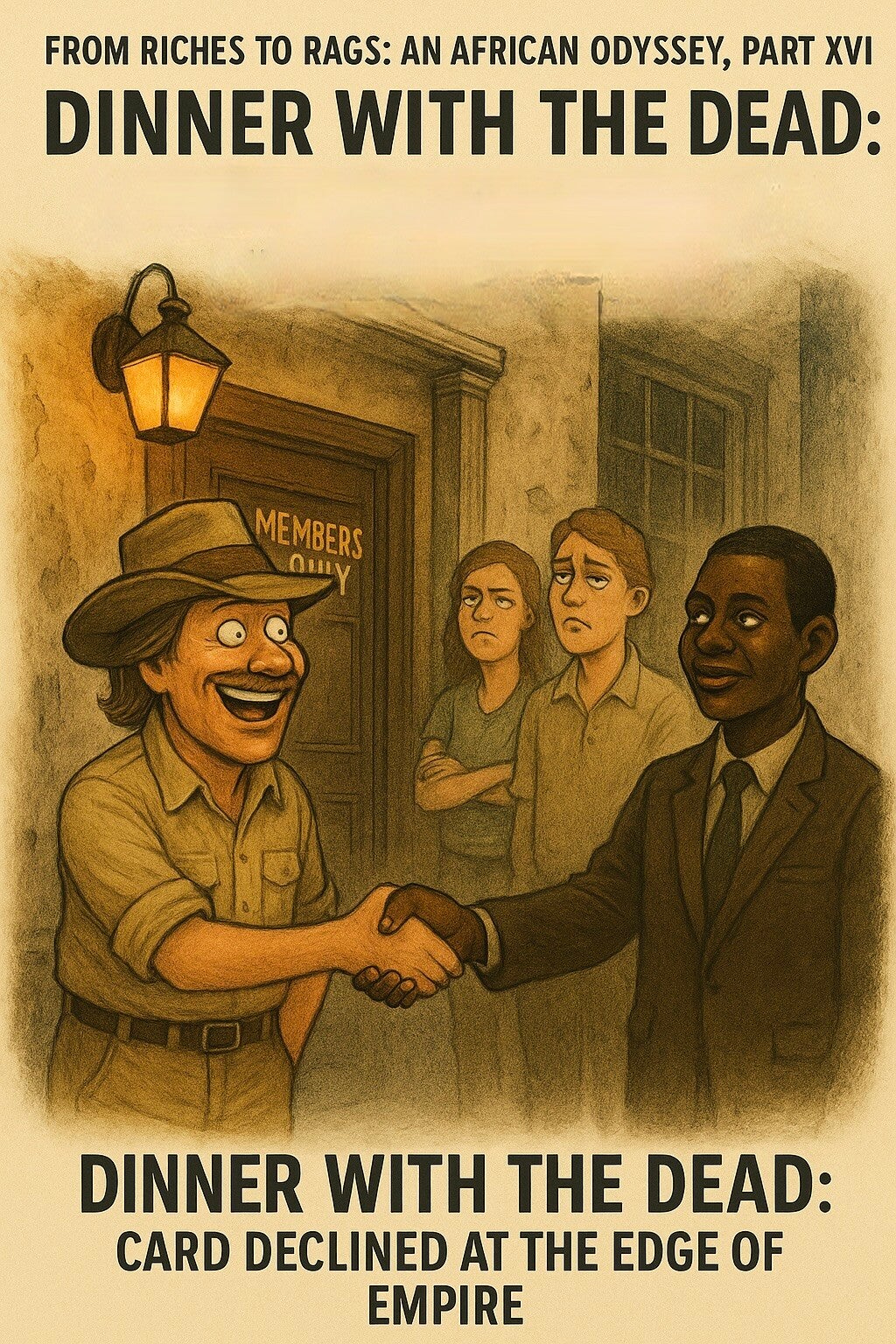
“Dinner with the Dead: Bureaucrats, Bush Pilots, and Other Things That Refuse to Die.”
Welcome to the VIP lounge of bureaucratic necromancy—where colonial rot meets curry regret, and nothing ever dies... it just gets reassigned to another department.
Our hero, armed with a cowboy hat, a naïve sense of justice, and a wallet full of misplaced hope, parks his smoking ProBox outside the aviation afterlife—where the dress code is “pale, polo'd, and preferably pre-war.”
Inside: curry cold enough to be weaponized, a rotting corpse of British decorum, and David #2 whispering from the shadows like a failed financial exorcist.
And yes, your card was declined. But don't worry—so was progress.

Meet the delusional optimist formerly known as “prepared.”
Cowboy hat on.
Cargo pants locked.
Sanity optional.
Moments before launching another ill-fated mission of goodwill, bureaucratic warfare, and aviation malpractice — with a smile only seen on lunatics and bankrupt motivational speakers.
This is Marcel Romdane, the Flightless Messiah, just seconds before the next international incident.
⚰️ Hope is not a checklist.
It’s a terminal condition. 🧨🧨🧨

“Card Declined at the Edge of Empire.”
Somewhere between delusion and diplomacy, the clueless Muzungu negotiates with David #1 while David #2 contemplates spiritual retirement. Nicole, already three breakdowns ahead, rolls her eyes with professional detachment.
Welcome to Chapter XVI of From Riches to Rags: An African Odyssey—where bureaucracy meets bad decisions in a members-only hellscape… and everyone forgot who invited the goat.
Kommentar hinzufügen
Kommentare