

Humans are hopelessly addicted to naming things. It’s as if our entire species collectively decided that assigning a string of syllables to an object would magically imbue it with personality, loyalty, and possibly the ability to love us back. Don’t believe me? Fine. Name one dog, cat, horse, tortoise, or even goldfish owner who hasn’t saddled their unsuspecting pet with a name so absurd it would make their ancestors weep. Go on. I’ll wait. Yeah. That’s what I thought.
But it doesn’t stop at animals. Oh no. We extend this madness to absolutely everything. Cars, motorcycles, boats, planes, chainsaws, lawnmowers, coffee machines, and—if you’re particularly lonely—even your toaster. Why? Because we’re emotionally stunted, sentimental primates who have tricked ourselves into believing that naming an inanimate object somehow strengthens our bond with it.
And honestly? It does. The moment you name your car Betsy, The Beast, or The Millennium Falcon, you can’t just abandon it when it breaks down in the middle of nowhere. You’re now emotionally compromised. That rusted-out, smoke-belching disaster isn’t just a vehicle anymore—it’s family.
An opening excerpt from What Could Possibly Go Wrong? Chronicles of Chaos and Courage remains available here. The full book can be ordered here.
🪦 TOTO – THE KID WHO NEVER STOOD A CHANCE

Maasai Mara, Kenya — 2013
This is Toto.
A teenage bull poisoned by greedy poachers for a pair of tusks barely big enough to hang a keychain on.
Four tons of pain, limping alone through the Mara, dying in slow motion while the conservation world focused on something far more important:
his name.
Because here’s the dirty gospel of wildlife philanthropy:
A nameless elephant is a statistic.
A statistic doesn’t raise money.
But “Toto, the Injured Young Elephant” — now THAT tugs credit cards straight out of wallets from Berlin to Boise.
Annette named him in tears.
Not because it helped him — it didn’t.
But because without a cute, pity-soaked moniker, no one donates a damn thing.
And so Toto was born — not biologically, but algorithmically.
What followed was biblical.
The self‑anointed elephant experts of East Africa erupted like we’d pissed on a shrine.
“How DARE you name him? Without consulting US?”
They clutched their pearls, wrote furious essays, probably lit incense — all while Toto kept limping, poisoning burning through his leg like a slow-motion execution.
But by then the public had seen his face.
And worse — they liked the name.
Try renaming an elephant after the internet adopts him; you’d have better luck exorcising a demon with a wet napkin.
Here’s the part everyone wants to ignore:
We don’t name elephants for THEM.
We name them for US — to make our empathy easier, our guilt softer, our donations feel noble.
It’s colonialism dressed up as compassion, branding wildlife like products because marketing performs better than morality.
Toto didn’t ask for a name.
He asked — silently, brutally — for the pain to stop.
And in the end, the system cared more about the branding than the bleeding.
📖 From What Could Possibly Go Wrong?
💥 Reality Level: Nuclear
🪦 Conservation Rating: “Please hold; your outrage is being monetised.”
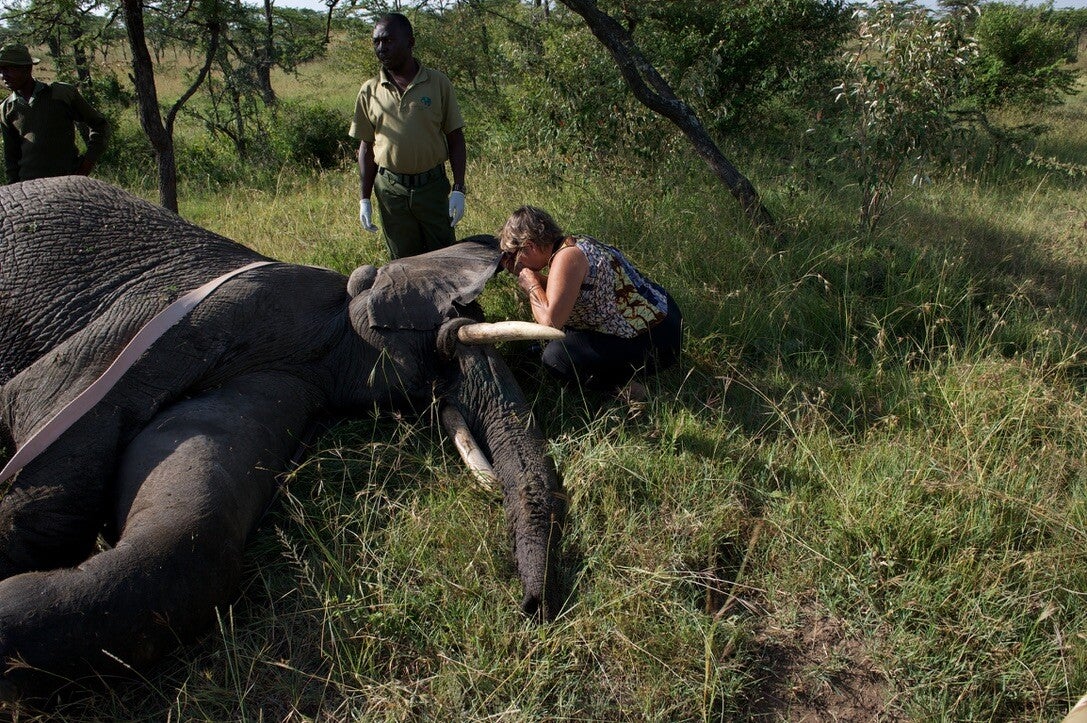
Toto wasn’t just a sedated four-ton teenager — he was the accidental poster child of a conservation story straight out of What Could Possibly Go Wrong?
Anette, our human leaking faucet and unofficial elephant therapist, knelt down and emptied her entire emotional hard drive into his ear while the rangers stood by, silently questioning their career choices and the sanity of the Muzungu circus around them.
This moment — raw, absurd, heartbreaking — is classic Romdane territory: one tranquilised elephant, one crying human, and a naming dispute that ignited half the charity ecosystem.
In the Mara, survival is messy. And apparently, so is compassion.

Toto from above — a bewildered adolescent elephant caught standing in the middle of the savannah like someone who misplaced both parents and survival instincts.
Meanwhile, my Super Cub’s shadow drifted across the grasslands like a bureaucratic omen, the airborne equivalent of a German audit.
This was the early insanity of Fly4Elephants: a young bull trying to make sense of life, and me circling overhead, blissfully unaware that this absurd partnership would one day detonate into a memoir titled What Could Possibly Go Wrong?
Erstelle deine eigene Website mit Webador