

TORQUE REACTION
Like Being Pushed by a Ghost With Boundary Issues
Okay, kid. Here’s the deal. When your engine spins the propeller in one direction (let’s say clockwise, if you’re sitting in the cockpit pretending to be Top Gun), Newton—this ancient guy with a wig and emotional problems—shows up and yells: “FOR EVERY ACTION, THERE MUST BE AN EQUAL AND OPPOSITE OVERCORRECTION THAT FLINGS YOU INTO THE BUSHES!”
That’s Newton’s Third Law.
It sounds helpful.
It’s not.
So while your big, shiny prop is spinning one way—like an overpriced blender full of angry air—your airplane reacts by trying to roll the opposite way.
Like a pissed-off Jolly Green Giant falling off a barstool.
And because taildraggers have two wheels up front and a glorified caster wheel in the back, this rolling motion doesn’t just tilt you sideways—
It twists the whole aircraft into a slow-motion spiral of self-sabotage.
Not dramatically.
Just enough to cause ripped canvas, bruised pride, and a confusing phone call to your instructor where you both pretend it was a mechanical failure.
This rolling motion doesn’t stay cute and linear.
It becomes yaw.
The left side of the runway starts looking cozy.
That’s why, on takeoff, your Cub starts flirting with the weeds, and suddenly you’re correcting with rudder, brakes, and whatever divine entity will listen to the prayer of someone who ignored the pre-takeoff briefing—and pinned all their faith on that one YouTube tutorial they half-watched at 2AM.
Now, during cruise flight at cruise power settings, the aircraft tries to neutralise torque with a buffet of mechanical wizardry:
Offset vertical stabilisers.
Angled engine mounts.
Asymmetric rigging that looks like it was designed during a hangover.
None of this helps you much on takeoff—
which, in case you’ve forgotten, is the phase where everything is trying to kill you.
We might dig into that cruise stuff later, but it’s not unique to taildraggers.
Which means:
Not my circus. Not my monkeys.
So, let me put it this way:
Imagine you’re riding a unicycle on a sheet of ice, juggling two raccoons—
and every time you accelerate, one of them slaps you in the face. From the side.
That’s torque.
Welcome to aviation.
How do you fix it?
You don’t.
You manage it.
You anticipate the twist.
You dance with it.
You apply right rudder like your ego, medical, and last shred of dignity depend on it—
because they do.
And you do this every single time you add power.
Even just a little.
Even when you’re taxiing.
Even when you think:
“This time it won’t bite me.”
Spoiler:
It will.
P.S. (The Doubtful Pilot’s Confession)
Look.
I’ll admit something here—and this might cost me a few points with the armchair engineers and forum gods:
I’ve never fully understood how something as seemingly innocent as a two-blade propeller on a glorified flying lawn chair can produce enough force to make the entire aircraft roll, yaw, and question your life choices.
I mean... really?
This much torque? From this engine?
It’s not a P-51.
It’s not strapped to a V-12 Merlin or cranking out 1,200 horsepower on a low pass over Berlin.
It’s a Super Cub.
It barely frightens squirrels.
So how exactly is this thing twisting the whole airframe like I insulted its mother?
But until someone can explain this in a way that doesn’t sound like a cult meeting at an EAA chapter, I’ll keep flying with one hand on the throttle—and one boot pressed so hard on the rudder pedal it leaves a dent in the firewall.
And in my soul.
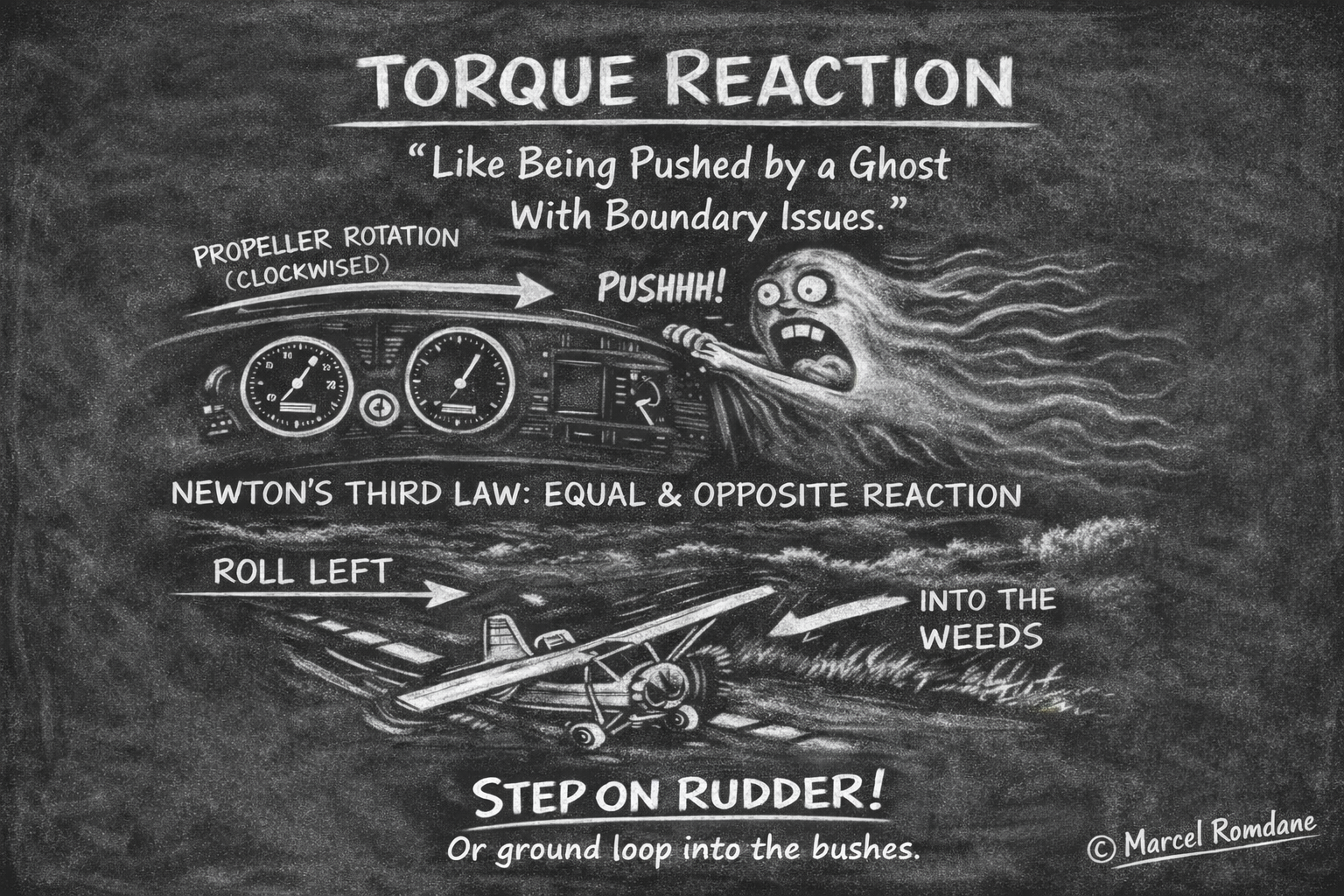
Torque Reaction — Where Newton Gets Personal
This is what happens when physics, bad decisions, and your Lycoming-powered canvas coffin with wings finally agree on something:
You're the weakest link.
And God?
He shrugs, mutters “not my problem,” and taxis out in a twin.
Your prop spins right. Your airframe lunges left.
You slam the throttle forward like it owes you beer money and declare,
“This’ll be no problem!”
—uttered with the suicidal optimism of someone who once tried to land downwind at 20 knots “just this once.”
And unless you stomp that rudder like Amelia Earhart in flip-flops, you’ll be exiting stage left into the weeds, the claims adjuster’s office, or the afterlife—
while what’s left of your Super Cub curls up in the bushes and quietly reconsiders its career path.
—Marcel Romdane
Stick, Rudder & Regret
Tailwheel Survival for Pilots Who Mistook Torque for a Myth
Kommentar hinzufügen
Kommentare