

There are moments in a man’s life when he realizes the circus isn’t just a metaphor—
It’s his home airport.
Complete with clowns in reflective vests, flaming paperwork, and a fuel truck driven by Kafka’s ghost on expired NyQuil.
After Arnie’s sermon on high-elevation grass strips—delivered with the casual serenity of a man who’d watched better pilots become botanical fertilizer—I was introduced to a new vocabulary. Not theoretical. Not poetic.
Biblical.
Density altitude.
Turnaround terrain.
Takeoff distance.
Crosswinds that slap you like a jealous ex with a weather license.
And somewhere in the oxygen-starved hills of Limuru, something… shifted.
No burning bush. No flaming elephant silhouette whispering “Trim for best glide.”
Just the slow, grinding horror that if I kept flying the way I’d been living—full throttle, nose high, brain parked in neutral—I wouldn’t be flying much longer.
At least, not horizontally.
The delusion that I was destined to become the greatest bush pilot since my Alaskan YouTube messiah, Paul Claus, didn’t die.
It got zip-tied to the jump seat—next to caution, begrudging respect, and a nagging suspicion that in Kenya, radio calls mattered more than testosterone.
Enter: David Mutawa.
AMREF’s high priest of piston-powered penance.
A man who didn’t speak much—because he didn’t have to. He could dismantle your ego with a sigh, a clipboard, and a single grease-stained eyebrow twitch.
He moved like a prophet of mechanical consequence.
The kind of man who could tell if you’d faked a torque spec just by watching your soul flinch.
The kind of man who'd seen enough do-gooder crashes to know: hope is not a checklist item.
At AMREF, the air didn’t just smell like avgas and rubber.
It smelled like judgment.
The slow-brewing despair of unpaid interns pretending they knew what a magneto did, while secretly Googling “What is left mag? Is it political?”
Dreams didn’t fly here.
They got logged, flagged, grounded, and dissected.
Hashtags? Laughable.
Your grand mission to “Save Elephants with a Taildragger”?
Cute.
You weren’t the first airborne idealist to flap into Wilson trailing donor smoke and ego exhaust.
And you wouldn’t be the last to crawl out reeking of Jet A, failed inspections, and corruption-induced PTSD.
Here, reality wasn’t symbolic. It came with a checklist:
- Were the bolts torqued to spec—or “faith-tightened by missionary optimism”?
- Had the invoices been paid—or just buried under a motivational quote?
- Were the right bureaucrats fed? At the right restaurant? With receipts?
- And was the fuel leaking out like hope at a shareholder meeting held inside a burning Land Rover?
This wasn’t a hangar.
This was a tribunal.
And Mutawa was holding the wrench, the clipboard, and your fate.
This was the crucible.
And I was no longer in Flensburg’s potato-strip fantasyland, where radio calls were optional, weather reports came with a smile, and the only other traffic was a drunk glider pilot who thought rules were for the French.
No.
This was Wilson.
Controlled airspace.
Swahili-English radio calls barked with the cadence of a hostile take-over.
Taxiways designed by satanic roundabout engineers who hated pilots.
Inbound heavies.
Ultralights behaving like caffeine-drunk mosquitoes.
Helicopters dancing like they’d skipped their meds.
And there I was—taxiing for the first time in my Cub, freshly reassembled after a mechanical séance, with Stanley squatting in the doorway like a prophetic goat sent by the aviation gods as a final warning.
Behind me:
A KCAA inspector gripping the compass like it contained his pension, his dignity, and the last thread of his faith in humanity.
Beside me:
The truth.
That if I was going to fly in Africa, it couldn’t be as a tourist.
Not as a saviour in Ray-Bans.
Not as a walking charity hallucination in aviator cosplay.
It had to be as a pilot.
A real one.
Or at least one being slowly reforged in the fires of African Airspace.
From this point on, I’d have to earn it.
Every call.
Every clearance.
Every suspicious compass swing that threatened to point directly toward the afterlife.
And in that hangar of tired tools and men who had long stopped believing in your dreams…
The transformation began.
Marcel Romdane:
No epiphany. Just consequences with a checklist.
✈️ File under: Things That Shouldn’t Fly but Will Anyway 🐘
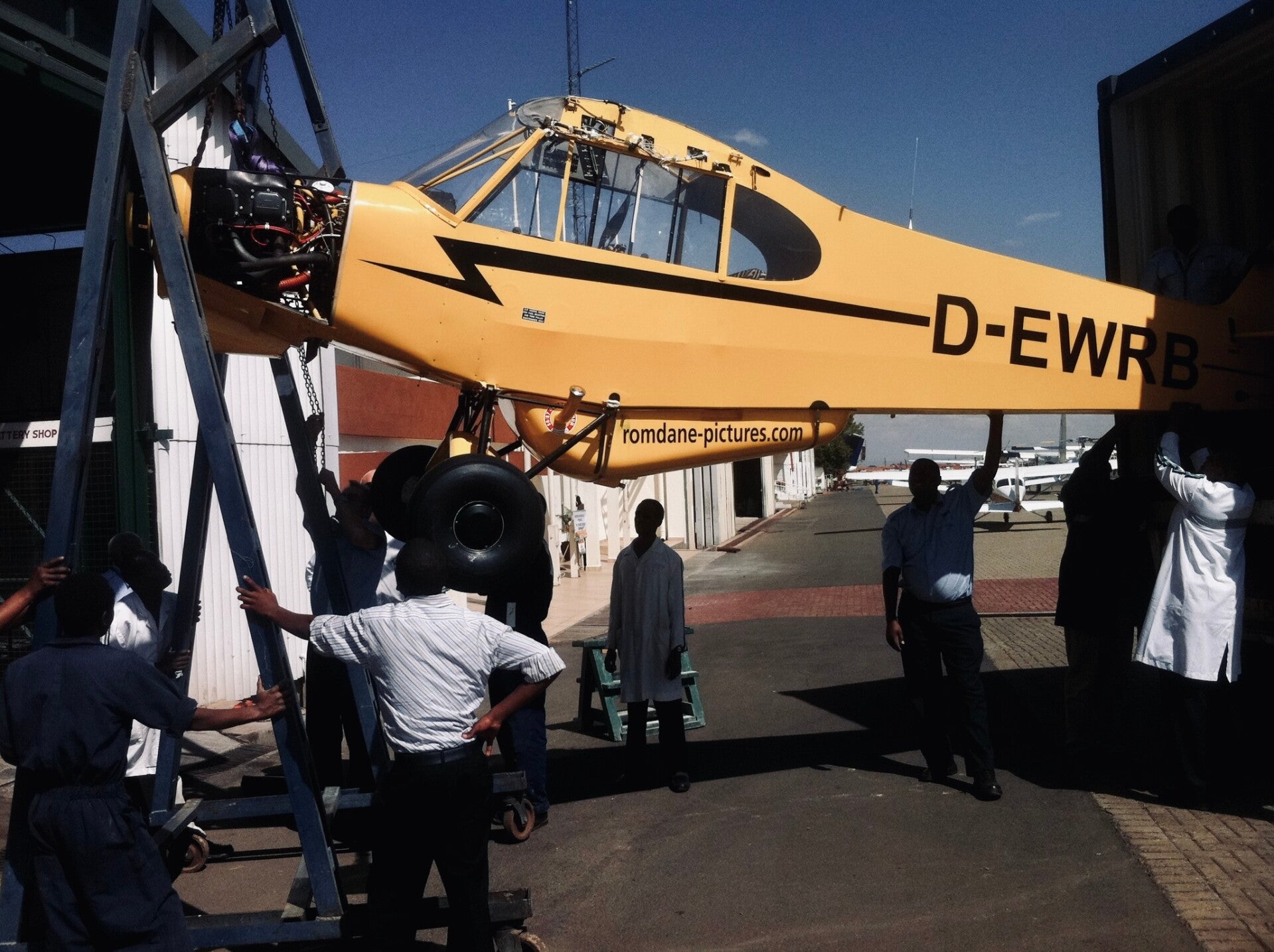
Finally, my Cub arrived at the AMREF workshop—sniffing Nairobi’s tarmac like a shell-shocked Vietnam vet on acid, fully expecting a napalm encore and a flashback-triggering goat.
A heroic number of aviation interns, mechanics, and vaguely concerned bystanders—none of whom were briefed on the aircraft’s psychological instability (or mine)—assembled to extract this honey-bee-coloured PTSD missile from her shipping coffin.
She’d survived the voyage from Germany jammed into a container like a disgraced U.N. diplomat smuggled out of a corruption scandal, only to now dangle midair—confused, yellow, and vibrating with prophetic doom.
This wasn’t a handover.
This was the exorcism of European optimism by African logistics.
This plane wasn’t just a flying machine.
She was a wrath-powered canvas coffin with wings, here to airstrike every last poacher like the ghost of every orphaned elephant had pooled their karma into one final, oily apocalypse.
She was about to unleash the righteous fury of a hundred thousand murdered tuskers—an airborne Old Testament smiting machine held together by zip ties, trauma, and my inability to accept reasonable advice.
First, of course, she'd have to survive Kenyan bureaucracy—a place where logic goes to die, get resurrected, then get detained for missing paperwork.
Somewhere behind a KCAA desk, Satan lit a cigar with an expired clearance form and nodded in approval.
Romdane Aviation was open for business.
The circus had a new ringleader.
And God was already filing for early retirement.
🐘✈️💥 Welcome to the flight plan from hell. 🧨🪦
AMREF Hangar, Nairobi — Day 2 of reassembly therapy.

There she stood: wings off, dignity low, nose up like a Botoxed aristocrat waiting for a scandal to pass.
My Super Cub, crucified on concrete, half-naked in a fluorescent-lit aviation purgatory.
On one side, her wings rested on wooden cradles like fallen angels too traumatized to fly.
On the other, I paced like a father waiting for the results of a paternity test that would determine whether his child was part helicopter.
The hangar reeked of solvent, sweat, and bureaucratic PTSD. Somewhere, an AMREF technician muttered a prayer in Swahili—not for safety, but for sanity.
The resurrection had begun. And if this bird ever flew again, it wouldn’t be through engineering—it would be pure vengeance and zip ties.
🛩️ Operation: Stitch the Bitch Together has entered Phase II. ⚰️
🛩️ Day 3: Kenyan Wing-Fitting Roulette
(or: How to Lose Faith, Sanity, and Possibly a Wing Strut)

This was the moment I became a devout Christian.
Not the peaceful, hymns-at-sunset kind.
The sweat-through-your-shirt, whispering-Hail-Marys-in-a-hangar kind.
Not because I’d found God in this mess—but because I had just handed over a priceless aircraft to a team of cheerful strangers who viewed torque specs as optional lifestyle suggestions.
My Super Cub—half-assembled, half-traumatized, fully uninsured—sat like a wounded warthog in the middle of the AMREF workshop, surrounded by well-meaning aviation mystics with no sense of time, but an unshakable belief in divine assembly.
I asked the question no man should ever ask in East African aviation:
“How long will this take?”
The reply was silence.
A deep, cavernous silence.
One man stared into the distance like he was reliving the final scene of a Swahili soap opera.
Another scratched his head for so long I began deciphering it as Morse code for run.
A third muttered, “Hakuna…” and left it hanging—like the other wing.
Somewhere behind me, a wrench sobbed into the red toolbox.
This wasn’t aircraft assembly.
This was emotional origami performed by a jungle-trained grease oracle and his apprentice, who wore zebra-print seat covers like sacred garments from a cult that worshipped poor life choices.
People fantasize about bush flying in Africa.
They imagine sunsets, elephants, and Top Gun fantasies with a tribal soundtrack.
What they don’t tell you—what no one ever tells you—is that first,
you must hand over your plane,
your wallet,
your patience,
and whatever illusion of control you carried into this hemisphere.
I was a muzungu with a head full of dreams.
Save the elephants. Fly for good. Bring aviation to the people.
Day three into Nairobi reality, I was already halfway to bankruptcy and three-quarters into an emotional breakdown.
And the left wing still wasn’t on straight.
⚠️ Day 4. 🛠️🪦

While I was hiding behind my camera like a war correspondent in denial, pretending not to notice that it took three adult men to agree on where the spark plugs go, Nicole had wisely aligned herself with the only man in the building who exuded actual competence: Stanley.
A benevolent mechanic in a fluorescent jacket and the calm aura of a man who’s seen things—like tailwheel landings and grown men cry.
In the background, stage left, we witness what can only be described as a war crime in aviation regalia: the Cessna 206 of Harro Trumpenau, painted in what I can only assume was a hallucinogenic fever dream during a KCAA licensing audit.
The result? A flying fruit salad with the temperament of a grounded toddler who tried to “surprise mommy” by repainting the kitchen—using ketchup, crayons, and jelly.
The Super Cub, by contrast, stood noble and violated—its prop half-mounted, its guts exposed, its dignity somewhere in customs clearance limbo.
At this point, I no longer knew whether we were rebuilding an aircraft or performing a complex spiritual exorcism. Either way, the wing still wasn’t on straight.
Coming to Africa to "make a difference" suddenly felt like showing up to a house fire with a glass of lukewarm rosé and the confidence of a white man in a TED Talk.
“Welcome to Nairobi, where time bends, tools teleport, and your airplane gets mistaken for a drying rack.

Within five minutes, every mechanic had vanished like guilt at a tax office audit. Gone. No note. No explanation. Not even a sarcastic ‘back in 5.’ My beloved Super Cub, the aircraft I’d shipped across continents like a deranged missionary with a propeller fetish, now sat alone—wings half-attached, tail buried under what appeared to be someone’s Sunday laundry.
The crate I’d spent two weeks clearing through Satan’s personal customs department now served as a lunch altar or impromptu desk for invisible employees. The right wing rested on a makeshift shrine of cardboard and hope, while a stray T-shirt dangled off the stabilizer like a flag of surrender to entropy.
This wasn’t just a maintenance delay.
This was a spiritual ambush.
A metaphysical reminder that I, Marcel Romdane, had officially crossed the Rubicon into a continent that eats scheduling for breakfast and burps bureaucracy by lunch.
And so I waited.
And prayed.
And considered making ‘Gone Missing’ flyers for the entire AMREF team.”
🪦 Romdane Aviation. Now 92% humidity, 4% wing, 100% delusion. 🛩️
⚠️ Day 26 of Delusion: The Moment Kenya Rewrote Aviation Physics. ☠️

The Unauthorized Return of the Flying Circus.
Behold the high-altitude answer to “How many humans can you fit into a Super Cub before the KCAA sends a sniper?”
Up front: me, your fearless idiot-in-command, freshly dusting off four months of potato-field muscle memory and wrestling with an aircraft a motley crew of AMREF mechanic interns had only recently reassembled—using prayers, questionable YouTube tutorials, and a set of torque wrenches that hadn’t been calibrated since the colonial era.
In the back: a visibly disturbed KCAA inspector, questioning every life choice that had landed him in this airborne therapy session, clutching his clipboard like it was a flotation device and silently praying the compass he came to calibrate wouldn’t end up pointing straight to the afterlife.
And then… Stanley. Hero. Hinge. Liability.
Perched halfway inside the fuselage like a misplaced hood ornament, our AMREF mechanic clung on with the elegance of a drunk goat at a trampoline park—equal parts spiritual exit interview and unauthorised stunt show. The aircraft hadn’t even moved and already we were in violation of seven laws, two aviation treaties, and basic physics.
The tower? Radio silence. Probably choking on their coffee, or phoning the national museum to ask if they wanted their exhibit back.
⚠️ Romdane Aviation: Where your compass gets checked, your common sense gets wrecked, and your soul files a flight plan for early departure.🛩️💛🪦🐐
⚰️ Preflight Confessional, Wilson Airport, Nairobi: Where Mechanics Go to Lose Faith 🪦

“Jesus, take the yoke. And sabotage the magnetos while you’re at it.”
Meet David Mutawa—head mechanic of the AMREF Flying Circus and reluctant grief counsellor to emotionally unstable Muzungu pilots with delusions of airborne heroism.
Here—with the expression of a man mentally composing his will—he leans into my freshly reanimated Super Cub, gazing into the cockpit like someone forced to disarm a homemade bomb using IKEA instructions and a plastic spork.
Maybe he was inspecting the throttle tension. Maybe he was praying the engine would seize before I hit 20 knots.
Most likely? He was weighing the legal implications of knocking me out cold with a torque wrench and dragging me off the airfield like an overzealous missionary.
Inside the plane: yours truly. Aviators gleaming. Confidence unjustified. A saviour complex so inflated it required its own luggage tag.
The Cub? Reassembled with expired Loctite, contradictory maintenance manuals, and something that looked suspiciously like chicken coop wire.
My last logged flight? Four months ago—over Germany’s pastoral potato fields. My current plan? Save elephants with a plane held together by hope and post-traumatic paperwork.
Mutawa didn’t speak. He just stared.
And in that stare echoed a silent gospel:
“Lord, if this idiot must fly, at least let him do it far from witnesses.”
🛩️💛🪦 Romdane Aviation: Engineering nightmares with spiritual overtones since 2012.
Now with more divine intervention, less bolt safety.
Kommentar hinzufügen
Kommentare