It was 10 p.m., and I was downright spent. I felt entirely out of my depth. Parked in the dark in front of Nairobi’s Westgate Shopping Mall, I had just removed eight dripping wet spark plugs from their sockets. Now, they lay neatly arranged around me in the cramped, filthy space under the hood of my car, each awaiting their turn to be dried and cleaned. A futile task, really. The moment they were scrubbed and screwed back in, they would foul up again within seconds, leaving me right back where I’d started.
For the third time that day, I found myself buried chest-deep in the grubby engine compartment of my capricious Land Rover. This miserable ritual had become absurdly routine. I was seriously contemplating relocating the steering wheel and driver’s seat to the engine bay since, at this point, I was spending far more time in here than in the actual cabin of this infernal piece of British rubbish.
As a result of the dire predicament I found myself in, my thoughts began to dangerously teeter on the edge of a full-blown mental breakdown. I even began entertaining the idea of setting this cursed car ablaze and simply walking away—back to the long-forgotten comforts of my home by the beach in Germany, never to return to Africa again.
Silently, I vowed to cheerfully embrace my profoundly boring and unfulfilling former life, returning to the monotony of alternating my time between managing my company and enduring the snobbish confines of a golf course. I even found myself looking forward to squandering weekends in toffee-nosed Armani stores or on race tracks, pretending to find joy in such hollow pursuits.
Perhaps, after this humbling reminder of how hard life can be when you strike out as a total stranger in a foreign land—a distant continent, surrounded by people you don’t understand, immersed in a culture alien to you, and on a naïve mission to save the world—perhaps now I could finally appreciate the so-called “normal” life.
Once again, my possessions would define my social standing and acceptance. All those long-lost friends, who had been quietly snubbing me, would likely welcome me back with open arms.
People back in my hometown wouldn’t see me as the Muzungu—a Swahili term for white greenhorns like me—but would greet me respectfully by name again. The bank manager would bend over backward, rushing out of his sad little cubicle to personally say hello every time I visited.
Standing alone in this desolate, oil-streaked parking lot, I almost found myself longing for the company of my shallow comrades. Indulging in vapid, meaningless conversations about even more trivial topics was beginning to sound strangely appealing.
Should I just call it quits here? What was I really trying to accomplish anyway?
Perhaps it was better to go home—to the care-free, insulated safety of my cozy comfort zone.
There would, of course, be a price to pay.
As part of my grand homecoming, I’d have to endure the smug “I told you so” barrage from my former associates, who would undoubtedly relish flinging it at me. I'd have to bow my head, concede my defeat, pick up a few bar tabs as penance, and move on.
Come to think of it, being a decadent, self-indulgent prick doesn’t sound all that bad, does it? At least I’d be in excellent company and could once again count myself among the blessed with “friends.”
Barbecues and ballgames for the rest of my life...
“Sir, I am hungry…”
Abruptly, I was yanked out of my comforting cloud of despair and self-pity.
“Sir, I am hungry…”
Apparently, I hadn’t been imagining voices. Reluctantly, I unfolded myself from the grimy engine compartment and looked around. In the distance, behind my vehicle, someone was loitering in the shadows, partly obscured by a lamppost, evidently attempting to communicate with me.
“What was that?” I yelled, since he was so far away.
Instantly, I regretted showing any reaction at all. Once you engage, you’re practically signing up for a relentless begging marathon.
A figure in an ill-fitting uniform waddled toward me. It was impossible to determine his role—postal worker? School janitor? Rent-a-cop from the mall? Pool attendant? An actual police officer? He could have been anything, really. Perhaps he wasn’t sure himself. Maybe this garment was a kind of all-purpose “Jack-of-all-trades” uniform, a relic passed down through his family as a means of scraping by.
“Sir, I am hungry,” he repeated, this time with almost saintly patience.
I stared at him, realising that if I didn’t respond, he’d likely stand there, calmly repeating himself until the end of time. His unwavering perseverance was, in its own way, admirable.
“Well, so am I,” I replied. “To tell the truth, I’m quite famished myself. Are you inviting me to dinner, officer?”
I wasn’t exactly in the mood for intricate games, so I opted to play the dumb tourist—oblivious, of course, to the complex dynamics of low-level corruption.
“No, Sir,” he responded stoically. “What I am proposing is that since I take care of you here, you might feel obliged to buy me supper. A pizza, perhaps?”
Ah, the plot thickens.
“How exactly are you taking care of me here? Did I miss some heroic action on your part, or does lurking behind lampposts qualify as public service these days? Or maybe you lent a helping hand with my fickle conveyance here?”
In truth, I was thankful for his sudden appearance. My mental state had been circling the drain, and this mildly amusing interaction was just enough to keep me from plummeting into the abyss—or, worse, strangling myself with the nearest spark plug wire.
“No, no, I could not help you with your car, Sir,” he clarified, maintaining his composure. “I am a police officer, after all.”
I failed to grasp the correlation between his profession and his inability to assist. Whatever happened to “to serve and protect”?
Never mind.
“Of course you are, my friend,” I said, barely stifling a sigh. “How about this: as a token of my ardent gratitude for your fine work, I give you three dollars for a pizza?”
I had identified the pattern. This could drag on indefinitely. Entertaining as it was, I needed to shoo this interloper away and return to the Sisyphean task at hand. Sweetening the deal, I added, “You know what? I’m sure you have a wife too, so let’s make it five dollars—you can even take some food home for your family.”
“That would be lovely, Sir! Thank you! I might add, though, that I have four children as well…”
“Don’t push it, officer,” I cut in. “Five dollars is more than adequate for your immense assistance. Of course, I could always go and discuss your current behaviour with your superiors instead?”
“No, no, this is not necessary, Sir! Five dollars will be plenty.”
I had to suppress a grin. With a practiced flourish, I handed over 500 Kenyan Shillings, waved him off, and watched him shuffle away into the darkness. As soon as he disappeared, I sighed, rolled up my sleeves, and climbed back into the greasy, unforgiving space beneath the Land Rover’s bonnet.
Corruption on a small scale, in my experience, isn’t necessarily a bad thing. Of course, most all-inclusive Club Med travellers from the sanitised enclaves of the Western world would vehemently disagree. “How dare you say that!” I can almost hear the outrage now.
But anyone familiar with the messy realities of living and operating in developing countries knows this simple truth: with a little grease, the machine runs not only better but far more smoothly.
As a guest in another country, it’s downright unwise to ignore its customs. If you want things to get done, you’d better learn to play to the tune of this universal code. It’s the same pattern anywhere—whether in Eastern Europe, North Africa, South America, or any part of Sub-Saharan Africa. Each time, a little bakschisch helps.
Contrary to popular belief, a bribe doesn’t always take the form of money. Sometimes, all that’s required is a smile, but more often than not, it’s about the exchange of small, useful tokens. That’s why I always travel equipped with an arsenal of pens, lighters, cheap digital watches, and other trinkets.
Offering straight cash can sometimes backfire—it might be taken as an insult. But leaving behind a lighter for the smoking officer who flagged you down or offering a half-full box of cigarettes? That’s a much subtler and more effective way to settle things. In the end, it’s not just about the money; it’s about the art of the exchange.
For instance, when I converted my pilot’s license in Kenya, I had the distinct pleasure of dealing with the KCAA—the local aviation authority. This institution operates on what can only be described as a geological clock. The only organisation that might surpass their glacial pace is the United States Postal Service.
To coax even the slightest reaction—let alone actual progress—required a bit of creative encouragement. For the modest price of a few BIC lighters for the office staff, a handful of pencils, and a pack of Marlboros, my application was instantly fast-tracked. Suddenly, my paperwork found itself on the rocket path of bureaucratic processing.
Meanwhile, two young aviators from the Kenyan island of Lamu, who had also earned their licenses in the U.S. and begun their conversions at the same time as me, refused to partake in any under-the-radar courtesies. Their principled stance netted them the moral high ground—and a five-month wait for their licenses.
As for me? My shiny new Kenyan Pilot’s License was handed over in just four weeks.
...Just saying.
I had picked up the helpful habit of practicing kind diplomacy during my time living in Mexico. In the little village of Playa del Carmen, where I spent most of my days, there was only one policeman. Being the obvious gringo, he took me under his wing and graciously educated me on the intricate art of proper bribery. His only request in return? A coffee, twice a week. From that point on, I never again had to worry about traffic violations of any kind.
Reflecting on the sudden appearance of my Kenyan policeman in the parking lot, I couldn’t help but acknowledge that the Lord truly moves in mysterious ways. Just when I was teetering on the brink of mental despair—overwhelmed by the endless list of things I had to handle alone and ready to abandon it all—He sent me this simple-minded saviour. It was as if to remind me that I was not alone, and that I never would be.
I may not be a quick learner, but this was a lesson I took to heart.
Amen to that.
Marcel Romdane
🧨 Land Rover Misery + Mental Collapse 💀
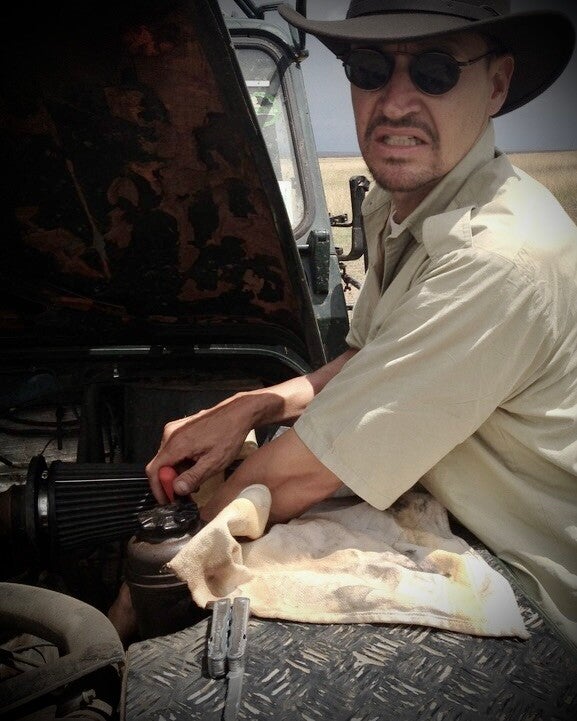
This was the moment—stranded in front of Westgate, Nairobi, elbow-deep in a Land Rover engine built by someone who clearly hated humanity, believed nuclear leaks were a healthy hobby, and probably drank embalming fluid for longevity—where I questioned every life choice that led me to this greasy abyss.
If frustration had a mascot, it would be this British engineering failure: a Land Rover—unreliable, oil-soaked, and hell-bent on killing its owner one breakdown at a time.
Drying eight spark plugs for the third time—each wetter than a yoga influencer realising her chakra retreat isn’t insured—I weighed my options:
• Step in front of a Matatu,
• Turn the engine bay into a controlled explosion and mail the ashes to England,
• Walk away forever and return to Germany’s spiritually vacant safety of golf courses and small talk with hedge-fund psychopaths.
But God—armed with a very dark sense of humour—had other plans for me.
What Could Possibly Go Wrong?
Ask Romdane. He bought a Land Rover.
The Gospel of Grease, ft. “Sir, I am Hungry”
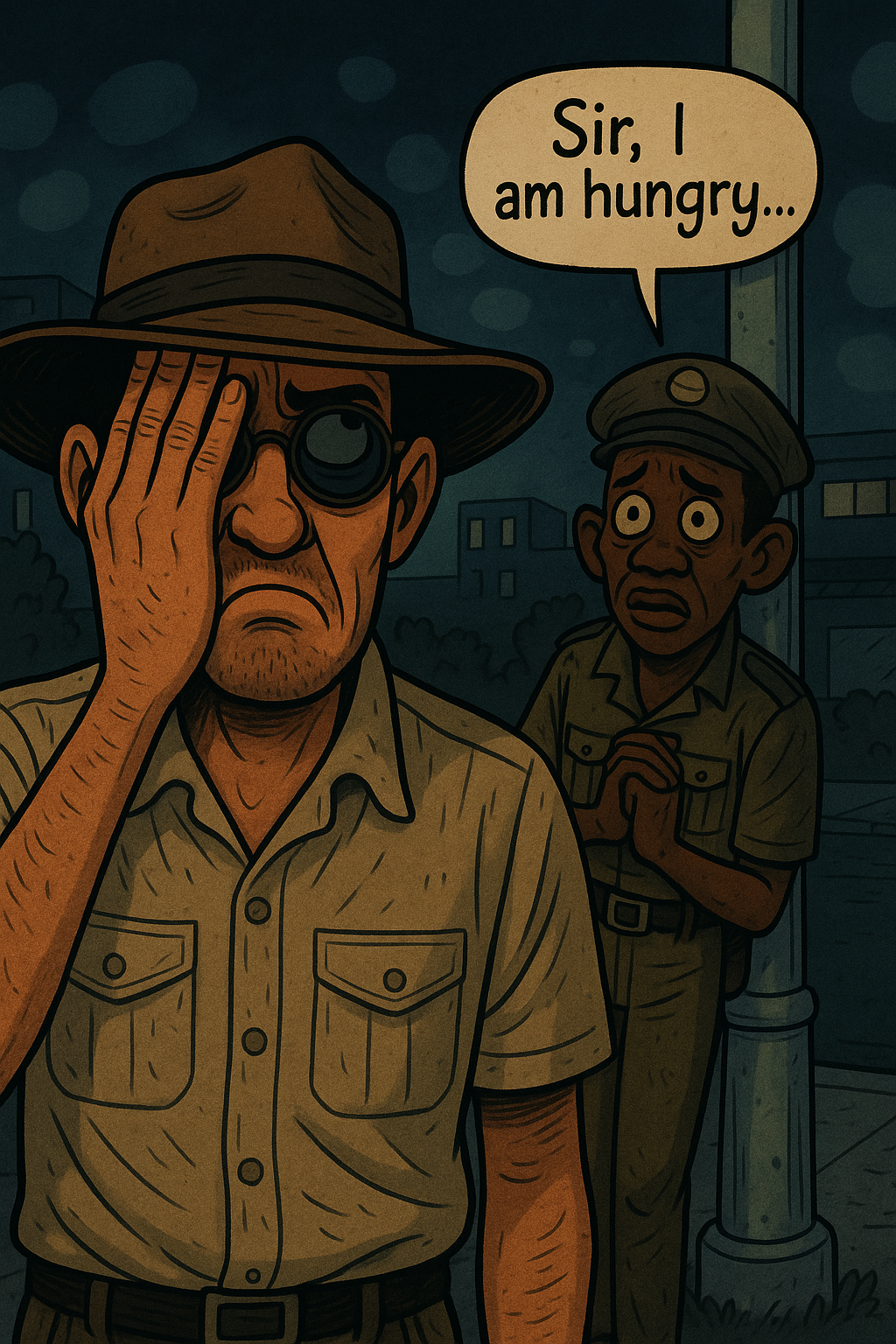
“Sir, I am hungry…”
He didn’t say “please,” or mention paperwork, or request a form in triplicate.
He just asked—politely, softly—for a little piece of human fuel.
So I handed him 500 Kenyan Shillings, and like an angel in a crumpled uniform, he disappeared into the night.
To the oat-milk-sipping influencers and Lonely Planet pilgrims who gasp at the mere mention of bribery: relax. In most of the real world, a small token isn’t corruption—it’s lubrication.
The machine doesn’t move without grease.
Out here, you don’t win hearts or solve problems with hashtags, policies, or scathing Instagram captions.
You fix it with lighters, pens, a cracked smile, or a pack of gum you forgot in your pocket.
Sometimes, even God sends help in the form of a hungry rent-a-cop in a crumpled uniform holding the last thread of your sanity together.
Western outrage can stay at the airport.
Because when your life is falling apart and your Land Rover coughs blood in a Nairobi parking lot at 10 p.m., the one man who shows up and says “Sir, I am hungry”
might just be the miracle.
What Could Possibly Go Wrong?
Ask Romdane. He paid the bribe. And he’s still here.
AMEN